
2016-03-07 00:00:00
By Karen Mills, Board member
Each year ArbitralWomen provides support for a number of teams competing in the Vis and Vis East Moot competitions, in Vienna and Hong Kong, respectively, by covering the registration fees for such competitions. Teams may apply if they are constituted of at least half female participants, and the awards are given to those applicants with the greatest need, normally teams from developing countries that do not have sufficient funding or resources.
The Vis competitions provide law students with an invaluable opportunity, effectively to handle a major international commercial arbitration, from pleadings to argument, invariably involving tricky issues, both procedural and substantive. The students who are chosen by their Universities to compete work very hard, over long hours, on top of their normal curriculum. Many of our members assist as coaches in their jurisdiction, and/or sit as arbitrators in the competitions, and are always impressed by the quality of these students’ work and performance. Hundreds of teams compete in both competitions. Originally the competition was held only in Vienna, but 13 years ago one of ArbitralWomen’s founders, Louise Barrington, initiated, and continues to administer, a second Vis, the Vis East, in Hong Kong, to make it easier for Asian teams to attend. The success of the Vis competitions is such that teams from all over the world now compete in both Vienna and Hong Kong every year.
While in the first few years we were able to fund only a few teams, in the past two years we have received some support from law firms, other organisations as well as individuals which has allowed us to assist more teams. Another innovation in the past two years is the “President’s Award”, which is sponsored by our President, Rashda Rana, for an all-female team. Last year the President’s Award went to University of Indonesia’s all-women team, competing in Vienna, which scored extremely well both for the team itself and some of its oralists. This year the President’s Award was given to Gujarat National Law University, who will also compete in Vienna. Rashda, together with Karen Mills, have administered these awards each year, this year with the assistance of Bronwyn Lincoln as well.
The recipients, and sponsors, this year were:
For Hong Kong’s Vis East:
1. Diplomatic Academy of Vietnam, award sponsored by Lara Pair, ArbitralWomen member;
2 & 3. Two awards were sponsored by Ashurst (thanks to Ben Giaretta): National Law School of India in Bangalore and Kyoto University.
And for Vienna’s Vis:
4. Kyoto University’s Vienna team, award sponsored by FTI Consulting (thanks to James Nicholson);
5 & 6. Two awards were sponsored by Perkins Coie (thanks to Paul Cohen): Washington University School of Law (in honour of the late Arthur Marriott), and University of Costa Rica; and
7. Gujarat National Law University received the President’s Award (thanks to Rashda Rana).
We wish, once again, to thank the sponsors for their very kind assistance, which has made it possible for these teams to participate.
We look forward to hearing good reports of our sponsored teams, and hope that more international law firms will consider participating in this highly valuable program by helping ArbitralWomen sponsor more teams in the future.

2016-03-04 00:00:00
By Lucy Greenwood, Board member
At the beginning of this year, ArbitralWomen began a pilot programme offering a corporate membership rate to a number of selected firms. We have been delighted by the initial uptake of this programme and plan to extend it further during the course of the year.
The corporate membership rate costs 650 Euros for up to 5 individual members from the firm, and a rate of 135 Euros is offered for each individual member from the firm thereafter. The response from the initial firms was very positive, with many firms keen to show their support for ArbitralWomen.
To date, corporate memberships have been taken out for 2016 by Allen & Overy, Clifford Chance, Freshfields Bruckhaus Deringer, Herbert Smith Freehills, King & Wood Mallesons, Latham & Watkins, Norton Rose Fulbright, Skadden Arps Slate Meagher & Flom, Squire Patton Boggs, Vinson & Elkins, White & Case and Wilmer Cutler Pickering Hale and Dorr.
We are very grateful for their enthusiastic support.

2016-03-03 00:00:00
ArbitralWomen has agreed to partner with Thomson Reuters who offers ArbitralWomen members free access to the complete Practical Law Arbitration Global Guide, Dispute Resolution Global Guide and Enforcement of Judgements and Arbitral Awards Global Guide published by Thomson Reuters.
In these guides, members find practical information on topical issues and country-specific Q&A overviews on arbitration and dispute resolution law and practice. They will also have access to our Q&A tool, allowing you to generate custom comparison reports for the jurisdictions and legal topics of their choice.
Global guides are written by leading local law firms, working together with Practical Law’s experienced editorial team and an International editorial board of expert practitioners. This helps to ensure the guide addresses the key issues facing any international lawyer doing business in an unfamiliar jurisdiction today.
If visitors would like more information on a contributing law firm or have any feedback about this guide, they may contact This email address is being protected from spambots. You need JavaScript enabled to view it. . For information about Practical Law, please visit uk.practicallaw.com or try the service for yourself by requesting a free trial today.
View Arbitration global guide
View Dispute Resolution global guide
View Enforcement of Judgements and Arbitral Awards global guide
2016-03-02 00:00:00
By Adela Llatja, Open Regional Fund South East Europe Legal Reform
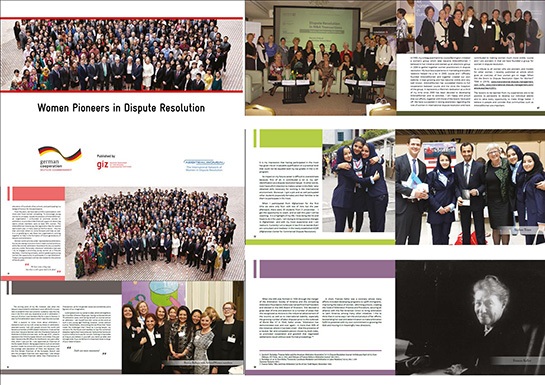
“Women Pioneers in Dispute Resolution” is a book showcasing the stories of a number of women in the field. The book is part of the project entitled “Gender Oriented implementation of the ADR instruments in the Western Balkan”, which is financed by the German Federal Ministry for Economic Cooperation and Development and implemented by Deutsche Gesellschaft für Internationale Zusammenarbeit (GIZ) GmbH, Open Regional Fund for South East Europe – Legal Reform (ORF LR). The project’s goal is to support the promotion of alternative dispute settlement mechanisms (Arbitration and Mediation) in the Western Balkans, especially by encouraging the participation of female practitioners.
Sharing successes and documenting them is a way to promote women’s contribution to dispute resolution. Sometimes young people need inspiration in order to choose their career path and such inspiration may be found in real success stories. GIZ ORF-LR and ArbitralWomen therefore collaborated to gather different stories from all parts of the globe in this publication.
The book is a small piece of the overall puzzle about how to promote women in dispute resolution. It reports on prejudices, societal structures, and missing networks, all of which women face every day. By analysing individual careers, opportunities and reporting on challenges from the daily lives of women working in arbitration, the obstacles become apparent.
It is a collection of stories by women for everyone, resulting in a colourful mosaic showing that equality still has not been fully reached, but also showing that women can do it and have done it — very often together with men! Facing challenges, prejudices, judgments, closed or missing networks, cultural barriers etc., those women succeed by working hard, desiring more, believing in people and themselves, never giving up, having passion and by daring.
Thank you to all who contributed, and shared their stories with us! Time has not permitted us to approach other reputed women pioneers, and some who were approached could not contribute due to their agendas.
The book is available for download here.
2016-01-27 00:00:00
By Board member, Ileana Smeureanu
ArbitralWomen was included last year on the list of non-governmental organisations with an observer status to participate in the sessions of UNCITRAL Working Group II on Arbitration and Conciliation. ArbitralWomen will be represented at the sixty-fourth session of the Working Group (New York, 1-5 February 2016).
The provisional agenda and related materials for each working session are available here. ArbitralWomen will not participate in the decision-making, but may be invited to take the floor to represent the views of the organisation on matters where it has expertise or international experience so as to facilitate the deliberations.
ArbitralWomen has established an active voice in dispute resolution because its members, collectively or individually, actively contribute to international law in various parts of the world. While our organisation focuses on women, the breadth of our activities are geared towards promoting their knowledge, access and involvement in the field of international dispute resolution.
As we embark on this new project of contributing to the work of UNCITRAL, we are taking our engagement to the promotion of international law one step higher and are very excited that our organisation has received this recognition.

2015-04-07 00:00:00
Arbitration analysis: Rashda Rana SC, barrister at 39 Essex Street Chambers and president of Arbitral Women, the international network of Women in Dispute Resolution, looks at the issue of the gender gap in arbitration.
IS THERE A GENDER GAP FOR WOMEN IN ARBITRATION?
Yes, certainly there is and it is unjustifiable. The high demand for arbitration services has driven many governments to cultivate a pro-arbitration environment through new arbitration legislation and other mechanisms, and has led to the proliferation of international arbitral centres throughout the world. Likewise, many global law firms have also responded to this increased demand by aggressively entering new markets and deploying significant resources to those emerging regions. The expansion of international arbitration into new regions as well as steady growth in more established markets has not, however, been reflected in the greater participation of more women. Women are not getting the same opportunities as men, regardless of background. Statistics published by arbitral institutions indicate quite strongly that, more generally, there is a severe imbalance in the vast number of appointments whether by the parties or by the institution concerned — for instance, the London Court of International Arbitration (LCIA) annual report for 2013 shows that in 2013, 9.8% of the 162 appointees selected by the LCIA and 6.9% of the 160 appointees selected by the parties were female. The LCIA is the only institution which actively pushes for the appointment of female chairs of tribunals. The appointment of European and American arbitrators usually account for a large chunk of the pie, within that the thinnest, barely visible slivers represent female arbitrators. Further analysis of the numbers indicates that things are not really improving. There are many studies which indicate there is a huge gender gap — for instance, the Institute for Continuing Legal Education in California has carried out studies which show that 85% of the women lawyers surveyed perceived a subtle, but pervasive, gender bias within the legal profession. Almost two-thirds agreed women lawyers are not accepted as equals by their male peers (see also 'Implicit Gender Bias in the Legal Profession: An Empirical Study' by Justin D Levinson & Danielle Young, Duke Journal of Gender Law & Policy Volume 18:1 2010). Despite the fact that approximately 60% of all law graduates are women, this figure steadily decreases over time and rank, such that, by the time we get to the managing partner level, only 4% are women.WHAT CAUSES OR PERPETUATES THIS GAP AND HOW DOES IT MANIFEST?
To some extent the problem lies in deep-rooted cultural perceptions and misperceptions. In every field unconscious bias is evident and perpetuated. Many studies (for example 'Science faculty's subtle gender biases favour male students' — Moss-Racusina, PNAS, 2012) show categorically that unconsciously, we tend to like people who look like us, think like us and come from backgrounds similar to ours. This means that white men choose white men for board rooms, as counsel, as arbitrators, as judges. The bias clearly is not always unconscious — sometimes it is deliberate negative bias. In the same report by the Institute for Continuing Legal Education, the findings were that 76% of those surveyed reported feelings of negative bias were from opposing counsel, 64% from clients, 48% from superiors, and 43% from peers. It is interesting to note that most feelings of negative bias were from opposing counsel, and the least was from peers. While 65% did not make any career changes due to these perceptions of negative bias, it is statistically significant that 35% did, and that 37% made no career changes because they believed it would not be any better elsewhere.DO YOU BELIEVE IN AFFIRMATIVE ACTION TO ADDRESS THE GAP?
Affirmative action has and can effect change. It has been pioneered in many different sectors:- the political arena for numbers of MPs in any one party
- in the commercial arena, with demands on boards of organisations to have a certain percentage of female directors
- in model briefing policies for female counsel to be briefed on cases
- in the judiciary for numbers of female judges