
2016-10-20 00:00:00
Hereafter is a message regarding the results of the IMI 2016 International Mediation & ADR Survey, which are now published on the IMI Portal.
In total, 815 participants completed this census survey, from mediation users, mediators, advisors, educators, students, providers and other stakeholders. The survey was designed to gather census data as well as views about Mediation & ADR Awareness. As statistical data in this area is still largely in its infancy, the results were particularly insightful and eye opening.
We very much appreciate the time and participation of all survey respondents. Their insight into conciliatory methods is of particular value to the Alternative Dispute Resolution community at a time when conflicts between businesses, governments and individuals are rapidly escalating on numerous fronts.
Certainly as IMI approaches its 10th anniversary, this information (and the many additional written comments submitted with this overview) will help us to prioritise efforts to raise the profile of mediation and ADR around the world. We hope the survey also inspires you to generate ideas in your own communities on how to continue to grow mediation and ADR as a viable alternative to drawn out legal proceedings.
Ute A. Joas Quinn and the Survey Team, International Mediation Institute, www.IMImediation.org
2016-09-27 00:00:00
We reported in Newsletter N° 18 that ArbitralWomen is delighted to be partnering with the Global Pound Conference Series (the “GPC Series”). This involves each organisation promoting the other on their respective websites.
The GPC Series 2016-2017 was initiated by the International Mediation Institute. It is a global project that aims, through a series of conferences currently being held throughout the world and involving a broad range of dispute resolution stakeholders, to find out what dispute resolution users need and want and to shape the future of commercial dispute resolution.
For those unfamiliar with the GPC Series, I highly recommend a visit to their website, www.globalpoundconference.org, where you can sign up for or become involved in a GPC event in your region of the world. So far, events have been held in Singapore, Lagos, Mexico City and New York. Next up are Geneva, Toronto, Madrid and Karachi.
The GPC Series also has a blog platform focusing on dispute resolution and access to justice. https://blog.globalpoundconference.org. AW member and GPC Series Blog Editor Natasha Mellersh is currently looking for contributors to the blog and editing assistance. The ideal candidate would be someone looking to gain experience in writing and editing who could assist on a voluntary basis. The work would involve editing articles, writing and researching relevant news items and short feature articles on themes/trends (300-800 words)
and interviewing prominent professionals in the field. The suggested commitment would be approximately 1-2 hours a week. Any AW member interested should email This email address is being protected from spambots. You need JavaScript enabled to view it. and include a short writing sample (200-300 words). The Contribute page can be viewed here: https://blog.globalpoundconference.org/about/contribute.
Gillian Carmichael Lemaire, advisory member of the AW Board and executive member of the Paris GPC committee
(The Paris GPC event will take place on 26-27 April 2017).
2016-07-13 00:00:00
The ICC International Court of Arbitration was among the first organisations to endorse the Pledge before it was even launched on May 18, since it signed the Pledge on 8 May 2016.
The ICC has participated in this initiative since Sylvia Noury started it in April last year and was represented by the author, who is also a member of the Pledge Steering Committee. The author indicated from the outset of this initiative that the ICC was willing to sign the Pledge and to contribute to increasing the number of women appointed as arbitrators.
The Pledge is a call to the international dispute resolution community to improve the profile and representation of women in international dispute resolution, and to commit to offer equal opportunities for equal qualifications.
The signature of the Pledge by the ICC is in line with the efforts undertaken in recent years to be more attentive to gender issues and nominate more female arbitrators and more female Court members. A year ago nine female and eight male vice-presidents were appointed, therefore with Alexis Mourre as President of the Court, equality of numbers at the Bureau of the Court was achieved. The number of Court members has increased in recent years and this trend will continue; in addition to the nine vice-presidents, 25 Court members are women. The total number of Court members including the President is 145, of which 34 are women, representing thus 23,5% of the Court members.
The ICC recently published a Note to the ICC National Committees and Groups about the proposal of arbitrators, in which those Committees and Groups are encouraged to observe generational and gender diversity. They are likewise encouraged, in their proposals of arbitrators, to favour gender diversity and diversity as to the various components of the local arbitration communities.
One of the steps recommended in the Pledge to measure progress is the tracking and publication of gender statistics for appointments of women arbitrators. In a landmark move, the ICC has published for the first time statistics on the gender balance of ICC tribunals. Women arbitrators represented just over 10% of all appointments and confirmations in 2015; 43% were appointed or confirmed as co-arbitrators, and 57% were appointed either as sole arbitrators (32%) or tribunal presidents (25%). The Court, thus, selects more women arbitrators than the parties.
The disclosure of gender statistics forms part of the ICC's on-going strategy to enhance both the transparency and diversity of international arbitration. The Court remains committed to enhancing the diversity of ICC tribunals and believes that the publication of annual statistics has a key role to play in this regard.
The ICC Court also decided in January 2016 to publish on its website the names of arbitrators sitting in ICC cases, their nationality, their role within the tribunal, whether their appointment was made by the Court or by the parties and whether the arbitration is pending or closed. This novelty is among several other measures that the Court has recently been adapting to move towards more transparency. The first names were published on June 27; two out of the six arbitrators were women.
“The ICC is deeply committed to improve the representation of women in international dispute resolution”, said Alexis Mourre, President of the ICC International Court of Arbitration. He added that “diversity is one of the fundamental keys for the future in arbitration. Arbitration will not survive if it remains a closed club of male, pale and stale practitioners”. Listen to the interview of Alexis Mourre, President of the ICC International Court of Arbitration: https://youtu.be/HyOcoe1BQCk.
As the number of players in dispute resolution from around the globe signing the Pledge grows every day, the author hopes that by committing together to change the playing field, we will attain a better representation of women on arbitral tribunals, considering the number of talented female practitioners.
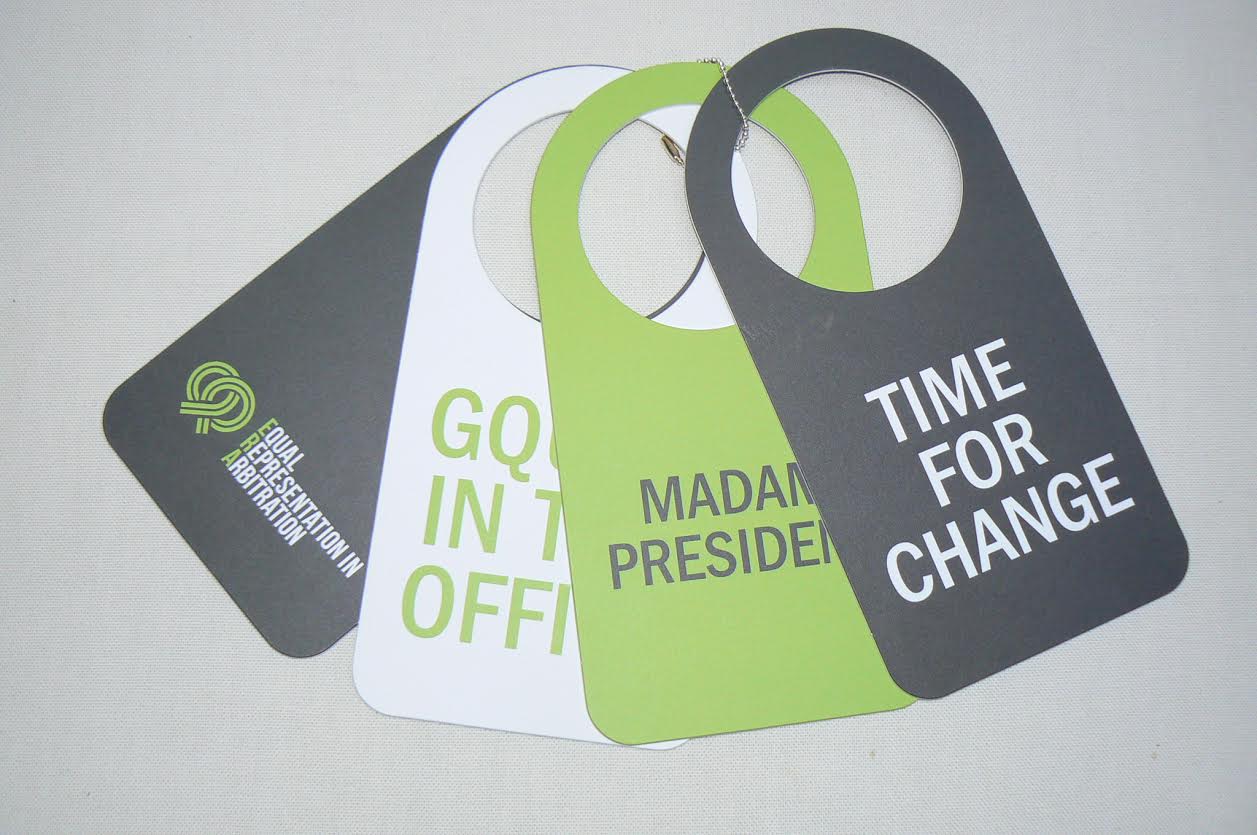
The photo represents a give-away offered at the launch of the Pledge in London on May 18.
Mirèze Philippe
Special Counsel at the Secretariat of the ICC International Court of Arbitration
Founding Co-President ArbitralWomen and Membership Director
Member of the Pledge Steering Committee
2016-06-22 00:00:00
UNCONSCIOUS BIAS: RECOGNISED AND MANAGED?
Rashda Rana SC, ArbitralWomen President I want to start with my own sub heading the subliminal message that I want to convey to you today:“The positive thinker sees the invisible, feels the intangible and achieves the impossible.”That’s what I want you to be from this day onwards. And why is that important? Because we want to eliminate discrimination, prejudice and bias on the road to equality We all know and have certainly heard that diversity is an important ingredient in corporate success since it:
- Creates greater creativity/reduction of “groupthink”: people’s experiences influence the way they see and resolve problems. Therefore, the more diversified a team is (be it lawyers or the arbitral panel), the more ideas will be presented and the greater the chance will be of obtaining the best possible result;
- Improves transparency/corporate governance;
- Increases performance, including financial;
- Results in greater retention of talents, which is especially important for law firms.
“A diverse and inclusive workforce is necessary to drive innovation, foster creativity, and guide business strategies. Multiple voices lead to new ideas, new services, and new products, and encourage out-of-the-box thinking. Today, companies no longer view diversity and inclusion efforts as separate from their other business practices, and recognize that a diverse workforce can differentiate them from their competitors by attracting top talent and capturing new clients.”So, if greater diversity and inclusivity are such fantastic goals, then why haven’t we leapt to the chance to achieve that goal in super quick time? Certainly for some years now there have been in place diversity awareness programs in many organisations. A 2009 review [2] (undertaken over a 5 year period looking at nearly a thousand studies) showed that the effects of most diversity efforts, including training, remain unknown, and a 2006 study looking at data from 708 private companies found that diversity training didn’t produce more diverse workforces. The problem identified as a result is that they weren’t taking into account all of peoples’ responses. One of the reasons behind why the goal hasn’t been achieved and why there is new thinking about how to improve diversity lies in the concept of unconscious bias, hidden bias, implicit bias. These biases are our “mental shortcuts based on social norms and stereotypes.” (Guynn, 2015). Over the last three decades, our understanding of unconscious bias has evolved. The nature of unconscious bias is well understood, and there is even an instrument (Implicit Association Test) to assess unconscious bias which has been developed and rigorously tested. A substantial amount of research has been published demonstrating the impact of unconscious bias in various arenas and how bias may be contributing to disparities in various industries. Here’s what we know:
- Unconscious biases develop at an early age: biases emerge during middle childhood and appear to develop across childhood (Dore, 2014).
- Unconscious biases have real world effects on behavior (Dasgupta, 2004).
- Unconscious biases are malleable, that is, one can take steps to minimize the impact of unconscious bias (Dasgupta, 2013; Dasgupta & Greenwald, 2013).
Why, sometimes I’ve believed as many as six impossible things before breakfast.It’s true I too have sometimes believed as many as six impossible things before breakfast. If I didn’t, if I couldn’t, then I wouldn’t, I couldn’t keep going with my own belief that equality is achievable and should be pursued. It gives me that determination to succeed in bringing about equality. I want you to visualize that seeming impossible being converted into reality because of your actions. We’ve probably all come across examples of unconscious bias at play in our everyday personal and professional lives but here are some kooky examples of unconscious bias but all of which could have an equally powerful impact. Studies have found that:
- blond women’s salaries were 7 percent higher than women who were brunettes or redheads.[3]
- for every 1 percent increase in a woman’s body mass, there was a .6 percent decrease in family income.[4]
- “mature-faced” people had a career advantage over “baby-faced” people (people with large, round eyes, high eyebrows and a small chin).[5]
- male and female scientists — trained to reject the subjective — were more likely to hire men, rank them higher in competency than women, and pay them $4,000 more per year than women (Wilkie, 2015).[6]
- Tall men in business may find unconscious bias to work in their favor. Fifty-eight percent of Fortune 500 CEOs are just shy of six feet tall, while only 14.5 percent of the male population are that same height. Tall men, then, tend to move into leadership positions far more frequently than their more diminutive counterparts (Price, n.d.). That would mean, for instance, that Napoleon is to be regarded as an atypical member of that group.
If you change the way you look at things, the things you look at change.'Feeling' unconscious bias I mentioned earlier that various institutions have developed tests for unconscious bias. What they also found was that even the very experience of taking a test of hidden bias may be helpful, many test takers said they could "feel" their hidden prejudices as they performed the tests. They can feel themselves unable to respond as rapidly to (for example) flower + unpleasant than to and pain + unpleasant. The very act of taking the tests can force hidden biases into the conscious part of the mind so that you become aware of them. We would like to believe that when a person has a conscious commitment to change, the very act of discovering one's hidden biases can propel one to act to correct for it. It may not be possible to avoid the automatic stereotype or prejudice, but it is certainly possible to consciously rectify it. Luckily, the mind and the unconscious within it are malleable. There are more than 150 identified unconscious biases, making the task of rooting them out and addressing them daunting. But, let’s look at a few of the known unconscious biases that directly impact the workplace and what we do and how we work and how we live. They include:
- Affinity bias: The tendency to warm up to people like ourselves.
- Halo effect: The tendency to think everything about a person is good because you like that person.
- Perception bias: The tendency to form stereotypes and assumptions about certain groups that make it impossible to make an objective judgement about members of those groups.
- Confirmation bias: The tendency for people to seek information that confirms pre-existing beliefs or assumptions.
- Group think: This bias occurs when people try too hard to fit into a particular group by mimicking others or holding back thoughts and opinions. This causes them to lose part of their identities and causes organizations to lose out on creativity and innovation.
- Develop concrete, objective indicators & outcomes for hiring, evaluation, and promotion to reduce standard stereotypes (Fiske & Taylor, 1991; Heilman, 2001; Bernat & Manis, 1994)
- Develop standardized criteria to assess the impact of individual contributions in performance evaluations (Heilman & Haynes, 2005)
- Develop and utilize structured interviews and develop objective evaluation criteria for hiring (Martell & Guzzo, 1991; Heilman, 2001)
- Provide unconscious bias training workshops for all constituents
- Promoting self-awareness: recognizing one’s biases using the Implicit Association Test (or other instruments to assess bias) is the first step.
- Understanding the nature of bias is also essential. The strategy of categorization that gives rise to unconscious bias is a normal aspect of human cognition. Understanding this important concept can help individuals approach their own biases in a more informed and open way (Burgess, 2007).
- Opportunities to have discussions, with others (especially those from socially dissimilar groups) can also be helpful. Sharing your biases can help others feel more secure about exploring their own biases. It’s important to have these conversations in a safe space-individuals must be open to alternative perspectives and viewpoints. This means developing the vocabulary for that discussion to take place
- Facilitated discussions and training sessions promoting bias literacy utilizing the concepts and techniques listed about have been proven effective in minimizing bias. Evidence suggests that providing unconscious bias training for faculty members reduces the impact of bias in the workplace (Carnes, 2012).
“Progress is impossible without change, and those who cannot change their minds cannot change anything”.In order to progress in society, in order to bring about the changes we’ve talked about today, we need to change our minds, deliberately, actively by being alert to and aware of our biases and acting to control them. I want to leave you with the same point at which I started and that is thinking about getting over the notion that some things are just impossible and not capable of being changed with the wise words of a civil rights activist who was otherwise generally known as The Greatest:
“Impossible is just a small word that is thrown around by small men who find it easier to live in a world they’ve been given to explore the power they have, than to change it. Impossible is not a fact. It is an opinion. Impossible is not a declaration. It is a dare. Impossible is potential. Impossible is temporary. Impossible is nothing!”
[1] Available at: http://www.forbes.com/forbesinsights/innovation_diversity/, consulted on January 27, 2016.
[2] Prejudice Reduction: What Works? A Review and Assessment of Research and Practice, Annu. Rev. Psychol. 2009. 60:339–67, by Elizabeth Levy Paluck (Harvard Academy for International and Area Studies, Weatherhead Center for International Affairs, Harvard University) and Donald P. Green (Institution for Social and Policy Studies, Yale University).
[3] Queensland University
[4] National Bureau of Economic Research
[5] Duke University
[6] Yale University
2016-06-13 00:00:00
Following the blog posted on Kluwer Arbitration Blog on 2 June 2016 concerning the Equal Representation in Arbitration Pledge interesting comments were added to the blog that we share with our readers.
This is a great initiative and I’m proud that my company, General Electric has signed on. The real challenge is now following through on our commitment by ensuring that we have consistently diverse slates when considering arbitrator appointments. Fortunately, remembering to propose diverse candidates is not a difficult thing to do.
My understanding of the pledge is like this. Let’s say you are the general counsel of a company with headquarters in Bulgaria and you do business in three regions around the world: South America, Asia-Pacific and Europe. There is a legal department in each region and each regional legal department currently keeps a list of five potential arbitrators to appoint if situations arise. Currently every candidate on each regional list is a suitable man. What you have to do then, is make this into three lists of five male/female pairs – for every male candidate you now have, you need to research and find a similarly suitable female candidate (in terms of expertise, experience, language, seniority, gravitas, cultural appropriateness etc.) Next time there is a dispute and someone has to make an actual appointment there you are, fully prepared with your pairs of suitable male or female candidates – which you can then consider for final selection. Once you’ve put your list together, whoever has it has an easy job of making an equal-opportunity appointment. If you discover you can’t put together such a list then you need to reach out to someone, e.g. Arbitral Women or something and get suggestions, then the whole process will keep moving forward. Is that something like the action that is expected right now of pledgors, Mirèze? What do you think Mike? What about other people? I’d be really interested to read about how pledgors have been interpreting / implementing their promises.
James, thank you for your comment. This is indeed in line with the actions expected from stakeholders, i.e. make sure women practitioners with equal qualifications are listed among potential arbitrators to be considered by the parties, their representatives, the co-arbitrators entrusted with the selection of the chair and by arbitration institutions. It is easier today to think outside the box because networks exist to assist in finding profiles, whether online or offline. For example, International Arbitrators Institute gathers a significant number of arbitrators’ profiles including women on http://www.iaiparis.com, and likewise the Who’s who http://whoswholegal.com. ArbitralWomen is willing to assist and is a unique hub for finding female practitioners through its ‘Find Practitioners’ feature on its website https://arbitralwomen.org. Practitioners also have their personal contacts to whom they may reach out to ask for recommendations.
2016-06-02 00:00:00
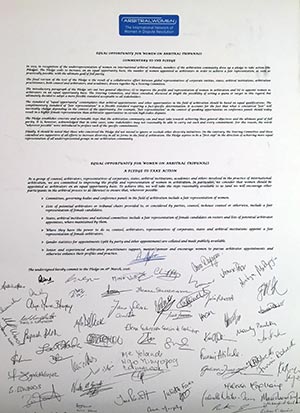
The launch and signature of the Equal Representation in Arbitration (ERA) pledge on 18 May 2016 in London marked a historic moment in international arbitration. The Pledge has already been signed by over five hundred individuals and around 70 organisations.
What is the Pledge?
The Pledge is a call to the international dispute resolution community to improve the profile and representation of women in international dispute resolution. Developed by a number of key players in the dispute resolution field and supported by Freshfields, the Pledge had its genesis in an idea suggested at ICCA 2014 by Jacomijn van Haersolte-van Hof, Director General of the LCIA, to ensure that concrete action was to address the gender imbalance in the appointment of arbitrators. The Pledge has been actively supported by ArbitralWomen since its conception. Actively championed by ArbitralWomen, we were also privileged to have three members of the ArbitralWomen board (Lucy Greenwood of Norton Rose Fulbright, Gabrielle Nater-Bass of Homburg AG, and Mirèze Phillipe, Special Counsel at the ICC) on the steering committee for the Pledge. On the occasion of the launch of the Pledge, Rashda Rana, President of ArbitralWomen, commented to Global Arbitration Review“(w)ith the Pledge, the arbitration community has moved beyond merely acknowledging the problem and articulating intent to do something about it. There is increasing recognition that the pace of change is unacceptable […] not just in the world of arbitration [but] in the judiciary and on corporate boards".To add symbolism to the moment, ArbitralWomen’s Board signed a hardcopy version of the Pledge at its second International Women’s day at UNESCO in Paris on 16 March 2016, and invited everyone there to sign it too, which they did. One of the steps recommended by the Pledge is monitoring and publication of gender statistics for appointments of women arbitrators. Lucy Greenwood has been advocating for several years for transparency in relation to this information and collated statistics from all the major international arbitration institutions in advance of the launch of the Pledge in order to establish a baseline from which progress can be monitored. ArbitralWomen strongly encourages all its members and supporters to visit www.arbitrationpledge.com to sign the Pledge electronically and show their support for this important initiative. Lucy Greenwood of Fulbright Norton Rose ArbitralWomen Board member