


ArbitralWomen is pleased to announce the results of the elections of its incoming Board of Directors for the 2018-2020 Term, which includes nine new members.
The incoming Board of Directors selected Dana MacGrath, counsel in the international arbitration group at Sidley Austin LLP, as President of the Board, and Asoid García-Márquez, in-house counsel at UNESCO, as Vice President.“I am honoured to have been selected to serve as President of the Board of ArbitralWomen and look forward to working with such a talented and dedicated group of women to promote diversity in international dispute resolution and advance our many projects, including the launch of the Diversity Toolkit at the end of this year,” said Ms. MacGrath. “Asoid García-Márquez is an ideal choice for Vice President. She brings years of experience on the Executive Committee of ArbitralWomen and has been leading the effort to modernize our corporate governance procedures. I am delighted to continue working with her.”The incoming Board members are from many countries and include arbitrators, in-house counsel, experts, practitioners and academics.
“It is amazing to see how we grew from a small group often meeting in Paris to a large network of female dispute resolution practitioners from around the world,” said Mirèze Philippe, ArbitralWomen co-founder and special counsel at the International Court of Arbitration of the ICC. “We have succeeded in raising awareness about the inclusion of female practitioners and opening doors for talented women. We are proud of our many achievements over the last two decades and are delighted to continue many projects and new programs with the incoming Board.”
“This is going to be a terrific Board, with some excellent energetic new members with great ideas for our future,” said Louise Barrington, ArbitralWomen co-founder and independent arbitrator. “I want to thank the fine women who did not get board seats this time for their commitment to ArbitralWomen and its work and I hope they will continue working with us and run again next term. I also want to thank those Board members who are leaving the Board for their dedication and service and look forward to their continued involvement in ArbitralWomen.”ArbitralWomen is an international non-governmental organisation for the promotion of women in dispute resolution. Over the past 25 years, ArbitralWomen has developed a number of programs to support the promotion of women in international dispute resolution as well serving as a leader in the efforts to recognise and overcome gender bias in the legal profession. Throughout 2018, ArbitralWomen has been celebrating its Jubilee with a series of events honouring its achievements and laying the groundwork for its work going forward.
Full Board of Directors for 2018-2020 Term: (new members indicated by an asterisk)
| Name | Nationality | Country of Residence |
|---|---|---|
| Barrington, Louise | Canada, UK | Hong Kong, Canada |
| Ben Mansour, Affef * | Tunisia, France | France |
| Burger, Laurence * | Switzerland | Switzerland |
| Burghetto, Maria Beatriz * | Argentina, Spain | France |
| Chessa, Valentine | Italy | France |
| Droulers, Diana * | Venezuela, France | Venezuela |
| Fortin, Juliette | France | France |
| Filhol, Gaëlle * | France | France |
| García Márquez, Asoid | Mexico | France |
| Gutiérrez García de Cortázar, Elena | Spain, Guatemala | France, Spain |
| Johnson, Alexandra * | Jamaica, Switzerland | Switzerland |
| Koleilat-Aranjo, Sara * | Lebanon, France | Dubai (UAE) |
| Lee, Amanda * | UK | UK |
| MacGrath, Dana | USA | USA |
| Mills, Karen | USA | Indonesia |
| Paralika, Marily | Greece | France |
| Pearsall, Alison | USA | France |
| Philippe, Mirèze | Lebanon, France | France |
| Smeureanu, Ileana | Romania, USA | France |
| Sucharitkul, Vanina * | Thailand, USA, France | Hong Kong |
| Williams, Erika | Australia | Australia |
| Woods, Louise | UK | UK |
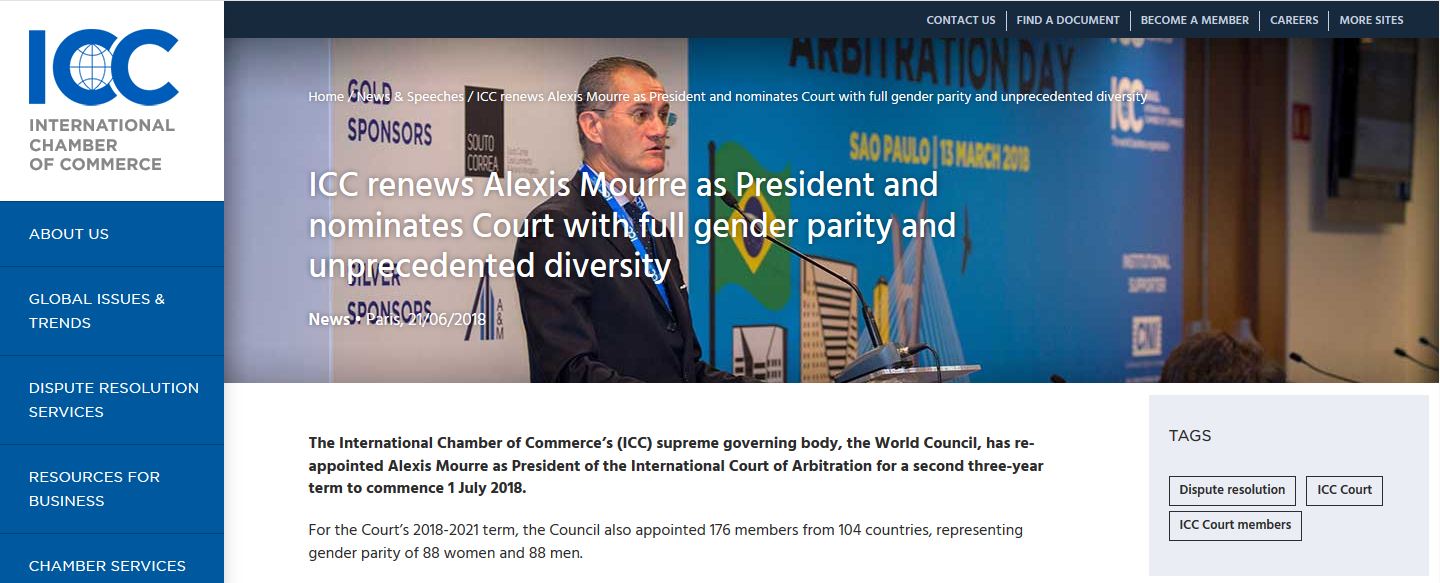
Unrivalled change! A huge progress achieved on the ICC International Court of Arbitration. For the Court’s 2018-2021 term, the ICC World Council nominated on 21 June 2018 Court members with full gender parity and unparalleled diversity (see ICC webstory). The percentage of female Court members has risen from 23% to 50%.
The author has presented some studies and empirical research in a variety of articles about women’s involvement in dispute resolution, and has published last year an empirical research on ICC female Court members (How has female participation at ICC evolve). An update on recent evolutions and statistics is published in the July 2018 issue of the ICC Dispute Resolution Bulletin. As of 1st July 2018, the 97 women who will sit on the Court represent half of the 194 Court members. ArbitralWomen is delighted to count many AW members among these Court members.Nine of the 97 members are vice-presidents:
- Yas Banifatemi (Iran),
- Chiann Bao (USA),
- Inka Hanefeld (Germany),
- Ndanga Kamau (Kenya),
- Wendy Miles (New Zealand),
- Yoshimi Ohara (Japan),
- Claudia Salomon (USA),
- Anne Véronique Schlaepfer (Switzerland),
- Deva Villanúa (Spain).
The 88 members are:
- Sabrina Ainouz (Algeria),
- Ana Vermal (Argentina),
- Jo Delaney (Australia),
- Anne-Karin Grill (Austria),
- Elham Ali Hassan and Aysha Mutaywea (Bahrain),
- Françoise Lefèvre (Belgium),
- Nadine Dossou Sakponou (Benin),
- Zinka Grbo (Bosnia and Herzegovina),
- Eliane Carvalho (Brazil),
- Ina Popova (Bulgaria),
- Helen (Hong) Shi and Cathy Liu (China),
- Lillian L. Y. Chu (Chinese Taipei),
- Monica Jimenez (Colombia),
- Monica C. Fernandez-Fonseca (Costa Rica),
- Marina Kralj Milisa (Croatia),
- Maria Amparo Santana Calderin (Cuba),
- Michelle Sindler (Czech Republic),
- Henriette Gernaa (Denmark),
- Samaa Haridi (Egypt),
- Triinu Hiob (Estonia),
- Leyou Tameru (Ethiopia),
- Anna-Maria Tamminen (Finland),
- Christine Lecuyer-Thieffry and Carine Dupeyron (France),
- Ketevan Betaneli (Georgia),
- Anke Sessler and Dorothée Ruckteschler (Germany),
- Marietta Brew Appiah-Opong (Ghana),
- Niki K. Kerameus and Marily Paralika (Greece),
- Rose Rameau (Haiti),
- Kim Rooney (Hong Kong),
- Marianne Kecsmar (Hungary),
- Pallavi Shroff (India),
- and Laya Joneidi (Iran),
- Louise Reilly (Ireland),
- Samantha Nataf (Israel),
- Cecilia Carrara (Italy),
- Yoko Maeda (Japan),
- Aigoul Kenjebayeva (Kazakhstan),
- Njeri Kariuki (Kenya),
- Natalia Alenkina (Kyrgyzstan),
- Galina Zukova and Eva Kalnina (Latvia),
- Lara Hammoud (Lebanon),
- Farah Beitelmal (Libya),
- Renata Berzanskiene (Lithuania),
- Danela Arsovska (Macedonia),
- Sitpah Selvaratnam (Malaysia),
- Cecilia Azar (Mexico),
- Géraldine Gazo (Monaco),
- Tanja Planinic (Montenegro),
- Aïcha Brahma (Morocco),
- Marieke van Hooijdonk (Netherlands),
- Domitille Baizeau (New Zealand),
- Adedoyin O. Rhodes-Vivour and Yejide Osunkeye (Nigeria),
- Giuditta Cordero-Moss (Norway),
- Lubna Katbeh (Palestinian Territory),
- Beata Gessel-Kalinowska vel Kalisz and Malgorzata Surdek (Poland),
- Marta Cruz de Almeida (Portugal),
- Cristiana Stoica and Luminita Popa (Romania),
- Julia Zagonek (Russian Federation),
- Milena Djordjevic (Serbia),
- Smitha Menon (Singapore),
- Maja Menard (Slovenia),
- Mahlape Sello (South Africa),
- Patricia Saiz (Spain),
- Helena Dandenell (Sweden),
- Teresa Giovannini (Switzerland),
- Madeline Kimei (Tanzania),
- Vanina Sucharitkul (Thailand),
- Affaf Ben-Mansour and Sana Belaid (Tunisia),
- Bennar Aydodgu (Turkey),
- Maria Kostytska and Olena Perepelynska (Ukraine),
- Sophie Lamb and Juliet Blanch (United Kingdom),
- Maria Chedid (USA),
- Sandra Gonzalez (Uruguay),
- Feruza Bobokulova Zarifovna (Uzbekistan),
- Diana Droulers and Diana Paraguacuto-Mahéo (Venezuela).

New York, April 23, 2018 – The New York City Bar Association’s Arbitration Committee has released a report describing arbitrator appointment procedures of various arbitral institutions in commercial arbitrations.
The Report
“Arbitrator Appointment Procedures of Arbitral Institutions in Commercial Arbitrations” – provides guidance on arbitrator appointment options that may not be readily apparent from the institutions’ arbitration rules and websites. The arbitral institutions discussed in the Report are the American Arbitration Association (AAA) and its international arm, International Centre for Dispute Resolution ICDR); the International Court of Arbitration of the International Chamber of Commerce (ICC); the International Institute for Conflict Prevention and Resolution (CPR); JAMS; and the London Court of International Arbitration (LCIA). The report is designed to be user-friendly so that corporate in-house and outside litigation counsel can quickly learn about the arbitrator appointment procedures of various arbitral institutions with respect to commercial arbitrations. The information collected in the Report is the result of extensive research based on publicly available data, user experience, and interviews with representatives of the institutions. The institutions discussed were provided an opportunity to review and provide feedback on a draft of the section describing the practices of that institution. Each section of the Report provides an overview of the arbitral institution and the institution’s approach to the selection of both party-nominated arbitrators and institutional appointments. The Report also discusses the role of the institution as an appointing authority, in the appointment of emergency arbitrators, and in special situations such as multi-party arbitration, consolidated arbitration, arbitrations involving state entities, and small claims in expedited arbitration. The Report also discusses the institution’s approach to arbitrator challenges and replacement of arbitrators. Where applicable, the Report discusses the institution’s arbitrator list services. The report can be read and downloaded hereAbout the Association
The New York City Bar Association, since its founding in 1870, has been dedicated to maintaining the high ethical standards of the legal profession, promoting reform of the law and access to justice, and providing service to the profession and the public. The Association, through its 24,000 members, continues to work for political, legal and social reform, while implementing innovative means to help the disadvantaged. Protecting the public’s welfare remains one of the Association’s highest priorities. www.nycbar.org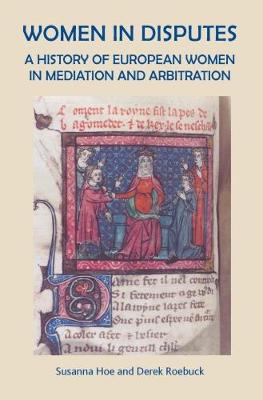
Susanna Hoe and Derek Roebuck
Finally, a book on the history of women in Malta has been written, and it is much more than a compendium of famous names.
'The value of Roebuck's series of historical studies in dispute resolution as a readable, reliable, comprehensive, concise and insightful resource simply cannot be overstated.'
From Homer to Jane Austen, storytellers have entertained their audiences with tales of women in disputes, as parties and peacemakers. This is our attempt to write their history, relying as far as possible on primary sources, documents which have survived by chance, never intended for our eyes by those who created and preserved them.
In 534AD, the Roman emperor Justinian expressly forbade women to act as arbitrators. In the thirteenth century Saint Thomas Aquinas stated that 'woman is naturally subject to man, because in man the discretion of reason predominates'. Many have assumed that what was laid down as law or proclaimed as authority represented the reality. But women do not always do what men tell them they should. We have set out to find what has happened in practice over 4,000 years, at least in Europe, beginning in the Bible and Ancient Greece and Rome, but thereafter concentrating on England, with regular references to the Continent. A chapter on Anglo-Saxon England shows the inextricable ties with the Continent among women of the highest rank, as do two of the four that follow on the Middle Ages. Those women often mediated and arbitrated, but they also resolved disputes by a number of other ways. Then we show how common it was for titled women in England to resolve disputes. A chapter on 'untitled women' provides plenty of evidence of the regular resolution of their disputes. There is a digression then to Malta, to the records of a fifteenth-century notary, which tell the stories of women of every station and their disputes. England's greatest monarch, Elizabeth I, supported women with free legal aid and her own personal interventions, in ways never since matched. The practice of submitting women's disputes to mediation and arbitration survived through the seventeenth century, despite revolution, regicide, fire and plague. A tailpiece tells how a dispute concerning the will of Temperance Flowerdew, one of the earliest European settlers in the 'New World', was resolved by the English Privy Council. A chapter on the 18th century emphasises the English Government's encouragement of mediation and arbitration, ending with how Mary Musgrove's mediation helped to establish the colony of Georgia, and two sections on France, one pre-Revolution, one Revolutionary. They challenge others to explore developments in the colonies and France. The Conclusion widens that challenge. Lady Anne Clifford, a woman of infinite strength of will, has demanded the last word. She simply refused a royal command to submit to an arbitration which would have robbed her of the vast landholdings she held in her own right.