

2020-05-11 00:00:00
On 1 May 2020, ICSID and UNCITRAL released the long-awaited Draft Code of Conduct for Adjudicators in Investor-State Dispute Settlement (“ISDS”). This commentary addresses the potential ban on double-hatting, in Article 6, and its impact on gender diversity. The specific draft provision is detailed below.
 Few, if any, would disagree that the international arbitration community as a whole benefits from diversity across all its members. It has been well acknowledged that gender diversity contributes to reaching better results due to the wealth that each talented individuals, men and women, bring to the tribunal. Indeed, concerns over the lack of diversity have prompted efforts to increase the pool of female arbitrators through the launch of the Equal Representation in Arbitration Pledge (the “ERA Pledge”) in 2016. Various arbitral institutions, law firms, corporations, and stakeholders have signed the ERA Pledge and committed to increase, on an equal opportunity basis, the number of women appointed as arbitrators with the ultimate goal of full parity. With over 4,000 signatories, the ERA Pledge serves as a testament to the international arbitration community’s recognition of the underrepresentation of women in international arbitration tribunals. In investment arbitration, however, these individual arbitrators would be primarily drawn from the ranks of counsel who must continue to practice unless and until they receive sufficient appointments to make full-time service as arbitrators economically feasible. Indeed, according to the 2019 ICSID Annual Report, 31% of female appointments were first-time appointees.
Barring individuals serving as counsel in ISDS proceedings from serving as arbitrators in investment disputes would reduce the overall pool of potential arbitrators, notably women, and deprive the parties of the ability to select the arbitrator of their choice. Of particular concern, an outright ban would undermine the efforts of the international arbitration community, including ArbitralWomen, to increase the number of females in arbitral tribunal panels. Representation of women in ISDS tribunals is particularly important because arbitrators render decisions that affect the public. ISDS decisions thus should reflect the make-up of those affected by their decisions. Therefore, any prohibition of multiple roles that would negatively impact diversity should be discouraged. Narrowly tailored disclosures, similar to the International Bar Association Guidelines on Conflict of Interest, would be more suitable and in line with international practice. It would also promote party autonomy, the hallmark of arbitration, and most notably the freedom to appoint arbitrators of choice.
Over the last two decades, the figures show that the appointment of female arbitrators is on the rise, but significant improvements are still needed.
Imposing a ban on dual hatting would be tantamount to reversing any progress made on gender diversity by the international arbitration community, including ICSID and UNCITRAL, over the past years.
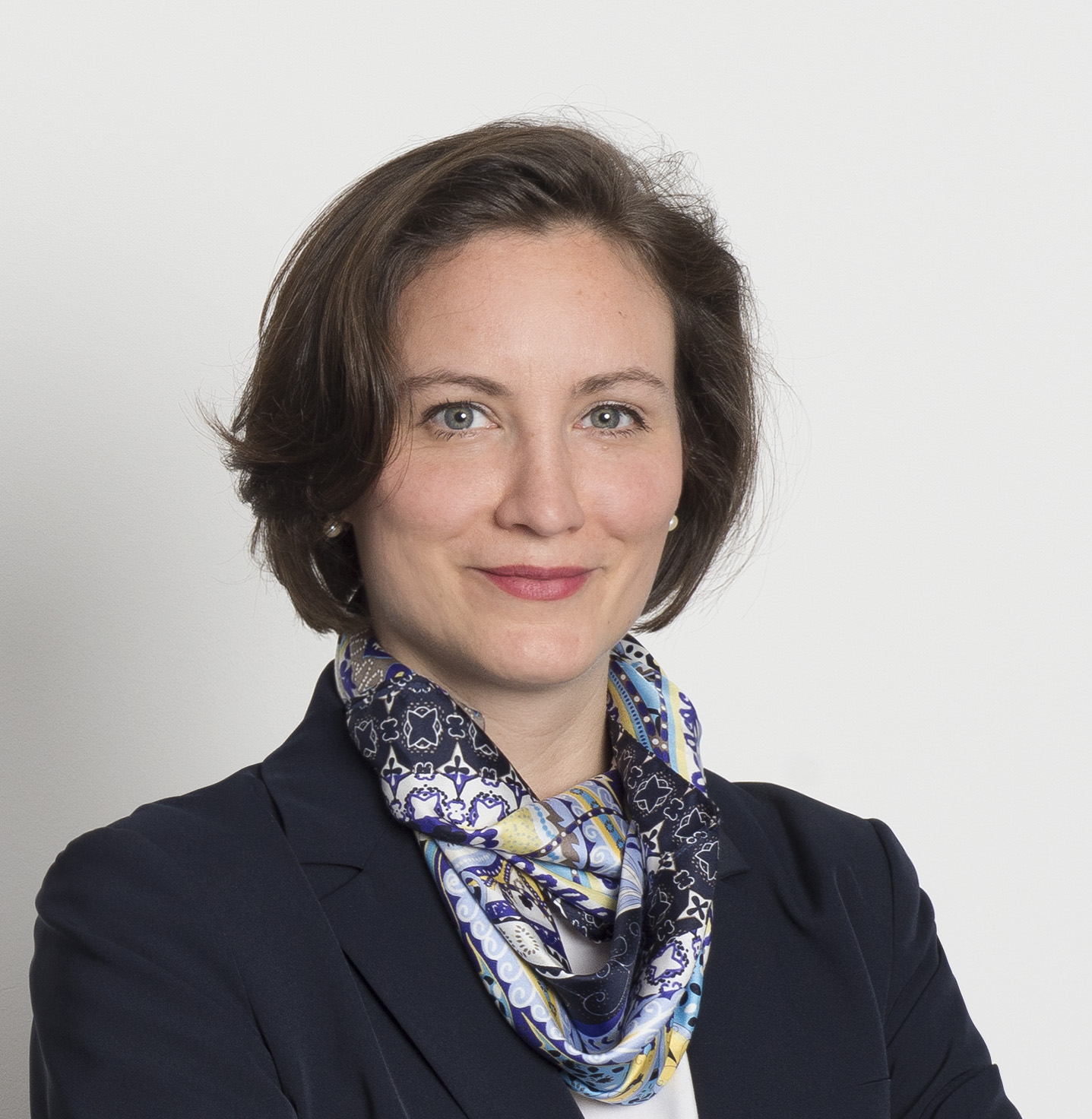
Submitted by ArbitralWomen Board Member Vanina Sucharitkul
Few, if any, would disagree that the international arbitration community as a whole benefits from diversity across all its members. It has been well acknowledged that gender diversity contributes to reaching better results due to the wealth that each talented individuals, men and women, bring to the tribunal. Indeed, concerns over the lack of diversity have prompted efforts to increase the pool of female arbitrators through the launch of the Equal Representation in Arbitration Pledge (the “ERA Pledge”) in 2016. Various arbitral institutions, law firms, corporations, and stakeholders have signed the ERA Pledge and committed to increase, on an equal opportunity basis, the number of women appointed as arbitrators with the ultimate goal of full parity. With over 4,000 signatories, the ERA Pledge serves as a testament to the international arbitration community’s recognition of the underrepresentation of women in international arbitration tribunals. In investment arbitration, however, these individual arbitrators would be primarily drawn from the ranks of counsel who must continue to practice unless and until they receive sufficient appointments to make full-time service as arbitrators economically feasible. Indeed, according to the 2019 ICSID Annual Report, 31% of female appointments were first-time appointees.
Barring individuals serving as counsel in ISDS proceedings from serving as arbitrators in investment disputes would reduce the overall pool of potential arbitrators, notably women, and deprive the parties of the ability to select the arbitrator of their choice. Of particular concern, an outright ban would undermine the efforts of the international arbitration community, including ArbitralWomen, to increase the number of females in arbitral tribunal panels. Representation of women in ISDS tribunals is particularly important because arbitrators render decisions that affect the public. ISDS decisions thus should reflect the make-up of those affected by their decisions. Therefore, any prohibition of multiple roles that would negatively impact diversity should be discouraged. Narrowly tailored disclosures, similar to the International Bar Association Guidelines on Conflict of Interest, would be more suitable and in line with international practice. It would also promote party autonomy, the hallmark of arbitration, and most notably the freedom to appoint arbitrators of choice.
Over the last two decades, the figures show that the appointment of female arbitrators is on the rise, but significant improvements are still needed.
Imposing a ban on dual hatting would be tantamount to reversing any progress made on gender diversity by the international arbitration community, including ICSID and UNCITRAL, over the past years.
Submitted by ArbitralWomen Board Member Vanina Sucharitkul
Article 6. Limit on Multiple Roles
Adjudicators shall [refrain from acting]/[disclose that they act] as counsel, expert witness, judge, agent or in any other relevant role at the same time as they are [within X years of] acting on matters that involve the same parties, [the same facts] [and/ or] [the same treaty].
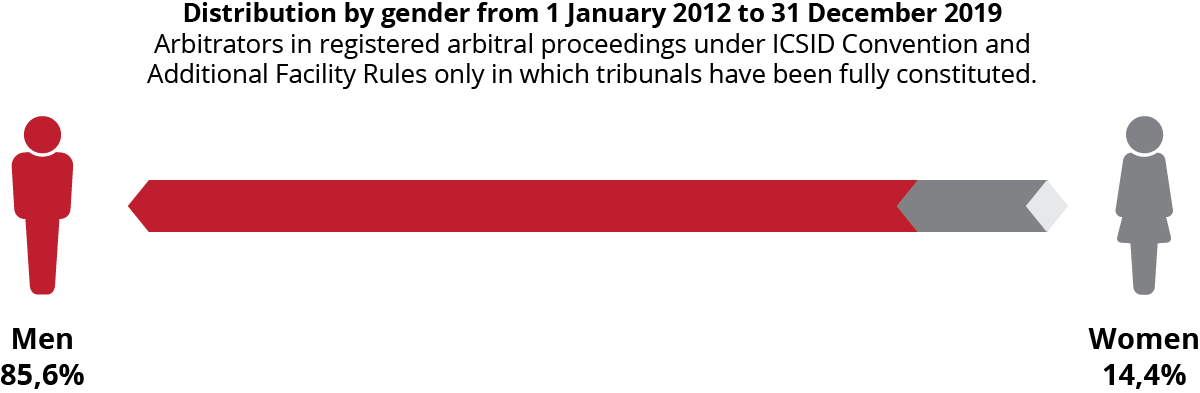
Comment 66 of the Draft Code of Conduct defines double-hatting as “the practice by which one individual acts simultaneously as an international arbitrator and as a counsel in separate ISDS proceedings.” The comment further states that for some, any concurrent representation creates a conflict of interest and therefore should be prohibited. For others, double-hatting is “problematic only in circumstances, where the facts or parties are related.” Moreover, Comment 67 states that “[a]n outright ban is easier to implement, by simply prohibiting any participation by an individual falling within the scope of prohibition.” Any sort of blanket ban on double-hatting would have the unwelcome effect of reinforcing the existing dominance of a relative handful of male arbitrators mostly from Western Europe and North America in the field of ISDS. In a prior study of 249 known investment treaty cases up to May 2010, only 6.5% were women. A recent survey of 353 registered ICSID cases from 2012-2019 reveals that out of 1,055 appointments, only 152 appointments were women – just 14.4 %. More striking, of all individuals appointed across all cases, 35 individuals were female and only two female arbitrators together comprise 45.3% of appointments of women. Thus, the underrepresentation of women in investment arbitration remains a dire problem.
2020-05-10 00:00:00
In April 2020, the 27th Annual Willem C. Vis International Commercial Arbitration Moot was concluded successfully – an outcome that only weeks before did not seem attainable in the face of the COVID-19 crisis.
Shortly after the necessary cancellation of the in-person oral hearings in Vienna at the end of March 2020, the Vienna Vis Moot Directors took the decision to conduct the oral part of the competition virtually – what at first seemed a “mission impossible” in the short period of time before the start of the competition.
Within only 6 weeks, this year’s Vienna Vis Moot became the center stage for putting digitalization and its potential use for virtual oral hearings in arbitration to the test by thousands of users.
Being the first event of its kind and size, the Virtual Vienna Vis Moot exposed not only the organisers to new challenges but also the students, arbitrators, coaches – and IT professionals. Over a period of six days, 560 hearings were conducted remotely, involving more than 3,500 participants from 85 countries. For a couple of days, the Vis Moot turned into what could be referred to as a “virtual hearing boot camp” or the largest worldwide “Virtual Hearing Centre”.
The Virtual Vienna Vis Moot gave the arbitration community the unique opportunity to test virtual hearings, which was for many of the arbitrators a totally new experience. What lessons could be learned? Most importantly, internet connections and bandwidth are differing in quality depending on where you are in the world. There are certainly some countries where the internet connections are not sufficiently reliable to easily replace an in-person hearing. The technical aspects challenged many of the participants. Getting a hearing up and running took more time than one would expect, in particular until everybody is settled and has sufficient audio and visual presence. Being well-acquainted with the communications system and having read the manual was important for smooth operations.
Each hearing was supported by a virtual room manager who was available to troubleshoot and provide guidance to participants on technical issues during the hearing. Overall, a majority of the hearings went very well with the technical support of the virtual room managers.
Dana MacGrath, ArbitralWomen President and Omni Bridgeway Investment Manager and Legal Counsel commented, “The hearing in which I served as arbitrator went very smoothly. While there were a few technical glitches at the start due to limited bandwidth of one of the arbitrators, once that was addressed with the assistance of the virtual room manager, the hearing went on without incident. The level of pleading was excellent, and shortly into the hearing I was barely aware that it was a virtual as opposed to in-person pleading. At the close of the hearing, the tribunal was able to deliberate in a private breakout room. Overall, it was very professional.”
Virtual hearings definitely require more prearrangements and preliminary deliberations of arbitrators and counsel than hearings in person. Simply because spontaneous interactions are limited including communications with colleagues, co-counsel or co-arbitrators. They also require a lot more concentration to monitor the screen with a lot of participants while still handling the substance of the dispute itself.
One of the most important aspects to keep in mind when taking virtual arbitration hearings into the “real world” is to ensure control over the different participants and their environments: With current systems, it is very hard to assess whether someone is getting unauthorized outside support or the hearing is recorded without permission.
The experience in the 27th Virtual Vienna Vis Moot showed that the technical developments are heading in the right direction and that the arbitration community is ready to take the next step toward virtual hearings as a real alternative to hearings in person. There is certainly still room for market improvements, especially in complex and document heavy arbitration, and not all online platforms provide the necessary features that are required for arbitration hearings.
The 27th Virtual Vienna Vis Moot has taken a first step to train thousands of participants in the conduct of virtual hearings and helped students to understand this as an option. What was greeted partly with scepticism and concern turned out to become a wonderful learning experience.
In terms of diversity, the trend of the last years continued and the Moot had a slight majority of 55% of all students that were female. This result fits seamlessly into the line of encouraging results that can be taken out of this exceptional Vienna Vis Moot year.
Submitted by ArbitralWomen Member Patrizia Netal, KNOETZL, Vis Moot Director
2020-05-10 00:00:00
Submitted by Dana MacGrath
Readers may recall our interview of ArbitralWomen member Dr. Katherine Simpson who, in January 2020, called on the Parties to the Comprehensive Economic and Trade Agreement between Canada, the European Union and its Member States (CETA) to remedy the serious under-representation of women in the agreed roster of arbitrators for dispute settlement under Article 29 of the CETA (“CETA List”).
The interview of Simpson entitled, “CETA List of Arbitrators – Where are the Women?” was first published in January 2020 by ArbitralWomen on our News Page. Thereafter, ArbitralWomen published an updated interview of Simpson in our recent Newsletter (April 2020, Issue No. 39) that can be accessed here (see Simpson interview on pages 4 to 8).
In response to the underrepresentation of women on the CETA List (where 50% of the Canadian, 20% of the EU, and 0% of the Chairperson roster nominees were female), Simpson provided the Treaty Parties the professional credentials of 70 women with specialised knowledge of international trade law whose skills and qualifications matched at least one person nominated to the CETA List. Her substantial research demonstrated what many already know to be true: there is no shortage of qualified women in international trade law or in international dispute resolution. Simpson also pointed out that there are no legal barriers preventing the Parties from remedying the gender imbalance because Article 29 of the CETA sets fifteen (15) as a minimum number of roster members and the list can be amended at any time. Simpson proposed that the CETA Joint Committee add additional female roster members until gender parity is achieved.
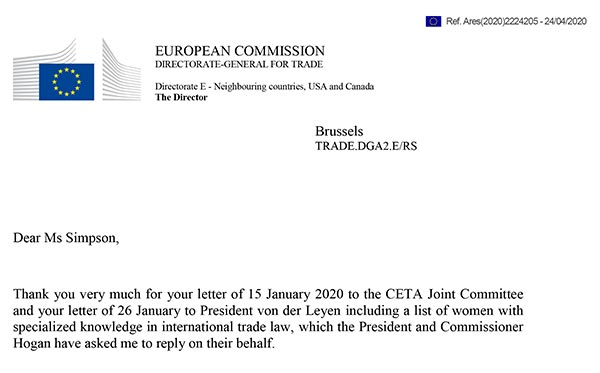
ArbitralWomen very recently learned that by letter dated 24 April 2020, the European Commission responded to Simpson’s CETA List submissions and that the European Commission has given permission for its response letter, which is available on Simpson’s website, to be shared publicly.
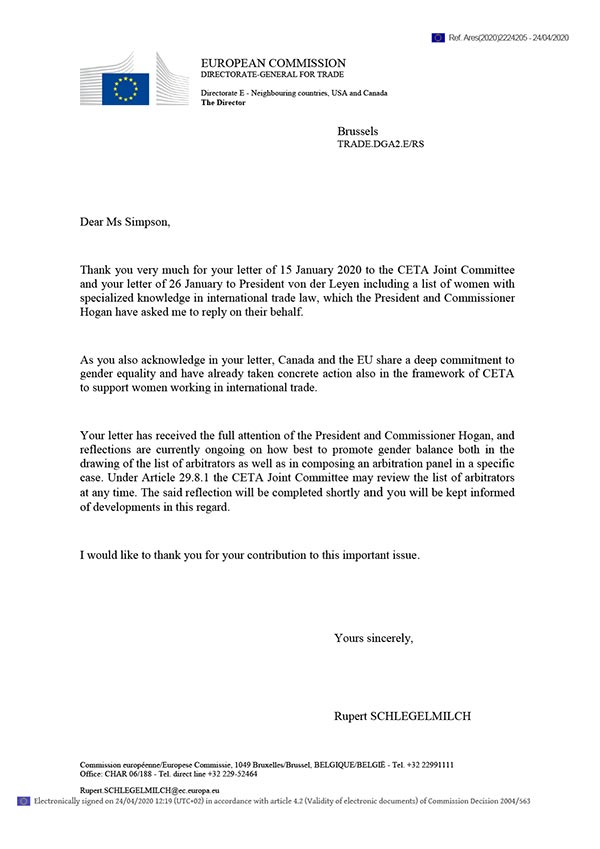 The European Commission's response letter states, in part:
The European Commission's response letter states, in part:
“Your letter has received the full attention of the President and Commissioner Hogan, and reflections are currently ongoing on how best to promote gender balance both in the drawing of the list of arbitrators as well as in composing an arbitration panel in a specific case. … The said reflection will be completed shortly and you will be kept informed of developments in this regard.”ArbitralWomen welcomes the European Commission's willingness to reflect on how best to promote gender balance in both the CETA List generally and in composing arbitral tribunals in specific cases. Simpson’s advocacy and persistence is an excellent example of what can be achieved when you “Walk the Talk” as discussed in the recent article by ArbitralWomen’s co-founder Mirèze Philippe, reported on our News Page here. As Simpson discussed in her interview with ArbitralWomen (available here in our recent Newsletter at pages 4 to 8), treaty-based lists of arbitrators, like the CETA List, serve as a public verification of the listed person's credentials, and these appear to be backed by public accountability. Moving toward gender parity in all dispute resolution arbitrator rosters will be a significant step toward achieving gender parity in international dispute resolution generally. There now is reason to believe that the CETA Joint Committee will create a balanced roster. In the response, the European Commission also stated in its response that, “under Article 29.8.1, the CETA Joint Committee may review the list of arbitrators at any time.” Already beginning to “walk the talk”, Simpson has advised ArbitralWomen that a draft decision of the CETA Joint Committee setting out the administrative and organisational matters regarding the functioning of the Appellate Tribunal envisioned in the CETA, published on 7 May 2020, refers to the importance of making appointments with a view toward gender equality. With Simpson’s list of 70 women with specialised knowledge of international trade law, Simpson urges that the CETA Joint Committee should have no difficulty identifying women for these roles. We are pleased to share this good news and congratulate Katherine Simpson on her work to highlight the gender diversity issues with respect to the CETA List.

2020-05-10 00:00:00
Congratulations to ArbitralWomen Board Member Gaëlle Filhol (Betto Perben Pradel Filhol) and ArbitralWomen members Ema Vidak Gojkovic (King & Spalding), Catherine Anne Kunz (LALIVE) and Claire Morel de Westgaver (Bryan Cave Leighton Paisner) for the launch of their initiative Mute Off Thursdays, an online initiative designed to bring together on a regular and all-virtual basis a group of women leaders in international arbitration.
In this challenging time of social distancing, Mute Off Thursdays comes as a much-needed energising way to help women stay connected, share knowledge, and meet, support and promote one another. Each week on Thursday at the same time, around 120 mid-level to senior women in arbitration from around the globe are invited to join a 30-min networking and knowledge-exchange video conference. At each session, a woman from the group makes a brief presentation about an issue that she encountered in her practice, such as an interesting arbitration procedural tactic, substantive argument, or soft-skills guidance. The presentation is then followed by a group discussion. To encourage an open exchange amongst the participants, the Chatham House rules apply.
Since the first session on 16 March 2020, the initiative has brought together some truly inspiring speakers. These have included ArbitralWomen member Samaa Haridi (Hogan Lovells), who spoke about virtual hearings, ArbitralWomen member Angeline Welsh (Essex Court), who discussed court orders against third parties in support of arbitration, ArbitralWomen member Claire Morel de Westgaver (Bryan Cave Leighton Paisner) on the duty to disclose WhatsApp and other instant messages, ArbitralWomen member Anna Masser (Allen & Overy) about emergency arbitration proceedings, and a coach in leadership, Montana Rozmus (CRA Inc.) on how partners and other management level professionals can strive to be an “admired leader” by delivering informal constructive performance feedback to associates and team members in a thoughtful and sensitive way to inspire high performance and foster a positive work environment.
Based on the success of the first four sessions, the project is well on its way to fulfil the organisers’ ambition to advance the exchange of knowledge and increase the visibility and profile of women.
Looking ahead, the upcoming sessions will include topics such ex parte arbitral interim relief, strategic issues in arbitration funding, women leadership in the virtual era, the practice and impact of tribunal deliberations, a bite-size update on arbitration-related court decision in England and in Switzerland, and using machine learning and game theory to improve predictability in international arbitration.
Due to online platform capacity constraints, for now the program remains invitation-only.
However, in case you wish to participate and satisfy the membership criteria (a woman with at least 7 years of practicing in the field of international arbitration), please feel free to reach out to one of the four organisers.
Congratulations again on this fantastic initiative!
[caption id="attachment_85668" align="aligncenter" width="802"]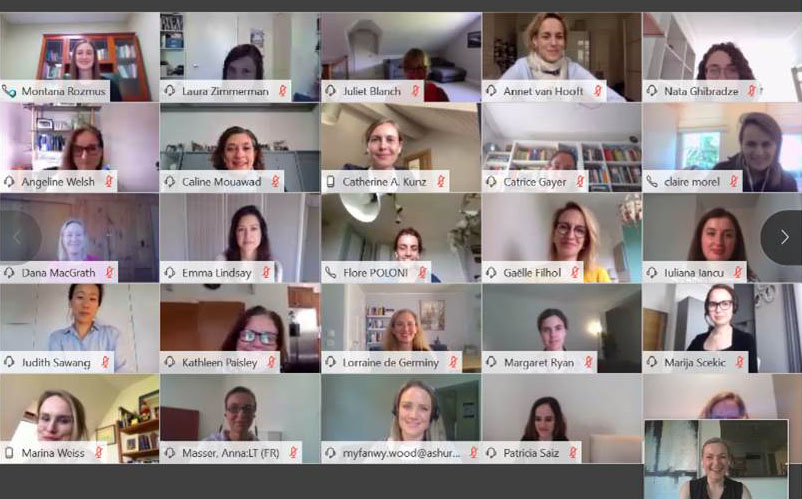 Mute Off Thursdays Fourth Session on 7 May 2020[/caption]
Submitted by Dana MacGrath, ArbitralWomen President and Omni Bridgeway Investment Manager and Legal Counsel
Mute Off Thursdays Fourth Session on 7 May 2020[/caption]
Submitted by Dana MacGrath, ArbitralWomen President and Omni Bridgeway Investment Manager and Legal Counsel
Mute Off Thursdays Fourth Session on 7 May 2020[/caption]
Submitted by Dana MacGrath, ArbitralWomen President and Omni Bridgeway Investment Manager and Legal Counsel 
2020-05-08 00:00:00
Many of our members are adjusting to the new normal of working remotely. Social distancing and travel restrictions have made it more challenging to network and make new connections from around the world.
 “ArbitralWomen Connect”, a new programme developed by ArbitralWomen member, Elizabeth Chan and open to members of ArbitralWomen, seeks to fill this void by matching members of ArbitralWomen with each other on a one-on-one basis. The purpose of the programme is to help our members to build meaningful connections with others in the same field and to help build solidarity in the international arbitration community during what is an extraordinarily difficult and isolating time. ArbitralWomen Connect is not a mentoring programme; the only commitment required of participants is that they meet with their match at least once – at a time and via a medium of their choice. We encourage participants to use this opportunity to make a new connection and to collaborate with each other on arbitration-related initiatives.
The pilot programme will involve 20 members and we will endeavour to match you with someone with whom you may have a shared interest.
If you are a member of ArbitralWomen and would like to participate, please complete the application form, available here, by 20 May 2020.
We look forward to hearing from you!
Submitted by Amanda Lee, ArbitralWomen Board Member, Consultant at Seymours, London
“ArbitralWomen Connect”, a new programme developed by ArbitralWomen member, Elizabeth Chan and open to members of ArbitralWomen, seeks to fill this void by matching members of ArbitralWomen with each other on a one-on-one basis. The purpose of the programme is to help our members to build meaningful connections with others in the same field and to help build solidarity in the international arbitration community during what is an extraordinarily difficult and isolating time. ArbitralWomen Connect is not a mentoring programme; the only commitment required of participants is that they meet with their match at least once – at a time and via a medium of their choice. We encourage participants to use this opportunity to make a new connection and to collaborate with each other on arbitration-related initiatives.
The pilot programme will involve 20 members and we will endeavour to match you with someone with whom you may have a shared interest.
If you are a member of ArbitralWomen and would like to participate, please complete the application form, available here, by 20 May 2020.
We look forward to hearing from you!
Submitted by Amanda Lee, ArbitralWomen Board Member, Consultant at Seymours, London
“ArbitralWomen Connect”, a new programme developed by ArbitralWomen member, Elizabeth Chan and open to members of ArbitralWomen, seeks to fill this void by matching members of ArbitralWomen with each other on a one-on-one basis. The purpose of the programme is to help our members to build meaningful connections with others in the same field and to help build solidarity in the international arbitration community during what is an extraordinarily difficult and isolating time. ArbitralWomen Connect is not a mentoring programme; the only commitment required of participants is that they meet with their match at least once – at a time and via a medium of their choice. We encourage participants to use this opportunity to make a new connection and to collaborate with each other on arbitration-related initiatives.
The pilot programme will involve 20 members and we will endeavour to match you with someone with whom you may have a shared interest.
If you are a member of ArbitralWomen and would like to participate, please complete the application form, available here, by 20 May 2020.
We look forward to hearing from you!
Submitted by Amanda Lee, ArbitralWomen Board Member, Consultant at Seymours, London 
2020-05-08 00:00:00
ArbitralWomen is delighted to be supporting two new webinar series from Delos Dispute Resolution presented by members of ArbitralWomen.
‘In Conversation with Neil’ invites members to join international arbitrator Neil Kaplan CBE QC SBS as he interviews leaders from the world of international arbitration and beyond, with ArbitralWomen member Chiann Bao serving as the master of ceremonies. Each conversation provides an insight into the career of Neil’s guests. Forthcoming webinars will feature ArbitralWomen members Wendy Miles QC and Lucy Reed, and Sir Bernard Rix. Watch previous episodes and register for your free place at the next ‘conversation’ here.
‘TagTime’, hosted by ArbitralWomen Board Member Amanda Lee and Dr Kabir Duggal, provides a forum for leading figures from the world of international arbitration to discuss substantive topics, including key cases and important procedural materials. Guests include ArbitralWomen member Janet Walker, Meg Kinnear, Doug Jones, Neil Kaplan CBE QC SBS, Bernard Eder and Gourab Banerji SA. Watch videos of previous episodes and register to attend the next episode here.
Submitted by Amanda Lee, ArbitralWomen Board Member, Consultant Seymours, London

|

|