

2021-04-28 00:00:00
ArbitralWomen is pleased to share news of the launch of “Ladies and Law” in Australia, a new networking group focused on promoting and empowering women in the legal profession.
Ladies and Law was co-founded by Kathryn Te’o, Special Counsel at GRT Lawyers with more than 10 years’ experience specialising in the construction and projects area of law with a more recent focus on construction disputes in the mining sector, and Erika Williams, ArbitralWomen Board Member and Independent Arbitration Practitioner with experience acting in some of Australia’s largest disputes resolved through arbitration and providing consultancy services to in-house counsel and firms involved in arbitration and cross-border litigation.
According to the Mission Statement of Ladies and Law, the group is “committed to supporting, promoting and empowering women in the legal industry to achieve success and reach their full potential.” The organisation strives “to provide opportunities for women to connect with and support each other in order to close the gap and achieve gender equality in the legal industry.”
[caption id="attachment_96083" align="alignright" width="239"]Kathryn Te’o[/caption] “Having worked in a heavily male dominated industry and specialty area of construction and projects, what I would like to achieve through Ladies and Law is to provide a networking group that contributes to the personal and professional development of our female members.” “We strive to shape the future of women in the legal industry by providing opportunities for development, fostering valuable connections, and facilitating member success through mentoring within a supportive network.”
— Kathryn Te’o, co-founder
[caption id="attachment_96091" align="alignright" width="239"]You can follow Ladies and Law on LinkedIn. ArbitralWomen congratulates the co-founders of Ladies and Law. We look forward to opportunities to collaborate with Ladies and Law to promote women and diversity in Australia and beyond. Submitted by Dana MacGrath, ArbitralWomen President and Omni Bridgeway Investment Manager & In-House Legal CounselErika Williams[/caption] “People often say it takes a village to raise children. I believe it also takes a village to strive for equal opportunities for women in law. Through Ladies & Law, we hope to create that village to support women to achieve and excel in our profession.”
— Erika Williams, co-founder

2021-04-14 00:00:00
Submitted by Dana MacGrath and Ema Vidak Gojković
In March 2020, as the COVID-19 pandemic was becoming a new reality for Europe and North America, ArbitralWomen member Ema Vidak Gojković came across the article The Pandemic’s Toll on Women: COVID-19 Is Gender-Blind, But Not Gender-Neutral by Melinda Gates suggesting that while we may feel “all in this together”, the consequences of the pandemic will not be the same for everyone: women’s professional lives will suffer more than men’s.
It was easy to see how her conclusion could prove true in the field of international arbitration. With the pandemic-created “social distance”, there was a real risk that women – already underrepresented on tribunals or in leadership / partner positions – would become more invisible and therefore fuel unconscious bias. Perhaps even more dangerously, women could lose ways to combat unconscious bias, such as by promoting one another. Losing visibility and solidarity sounded like a formidable blow for the progress achieved by women in international arbitration over the past decades.
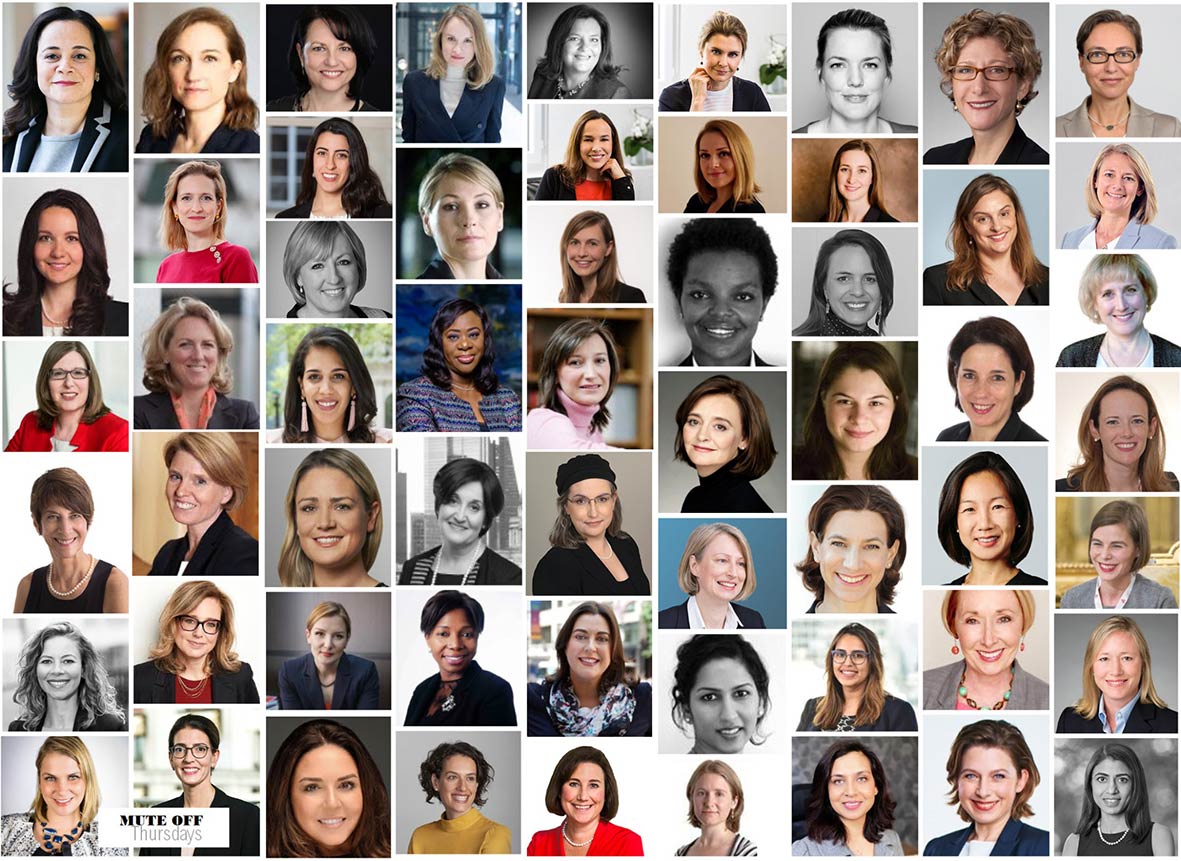
In response, four ArbitralWomen members, Ema Vidak Gojković, Gaëlle Filhol, Catherine Anne Kunz and Claire Morel de Westgaver decided to launch Mute Off Thursdays – an online forum designed to help mid-level to senior women in arbitration exchange knowledge and remain connected to the arbitration community by hosting a Zoom call for 30 minutes each week, same day, same time (Thursdays at 9am ET), with whoever can join.
Each week, a different woman from the group, including many ArbitralWomen Board members and members, talk about an interesting arbitration topic. Sometimes, external speakers were brought in to provide training about soft skills. To keep control over the administrative work, the group was made “invitation only” with the aim to accept all women who qualified by experience. Mute Off Thursdays started in April 2020 with 42 women. As of April 15, 2021, on the occasion of its First Anniversary, the number of women participating in Mute Off Thursdays exceeds 500.
The founders of the original Mute Off Thursdays are immensely proud of the Mute Off community they have helped build and thank the incredible speakers over the past year who made it possible to stay “stronger together” during the pandemic by leading powerful and engaging discussions each Thursday since April 2020:
 On Thursday, 15 April 2021, Mute Off Thursdays will celebrate its First Anniversary by hosting a special session about Imposter Syndrome & How to Overcome It with a star speaker – Dr. Valerie Young – an internationally recognized expert on impostor syndrome who regularly lectures on the topic and authored the award-winning book, “The Secret Thoughts of Successful Women”, in which she teaches practical ways to banish the intrusive thoughts that undermine women’s ability to feel — and act — as bright and capable as they truly are.
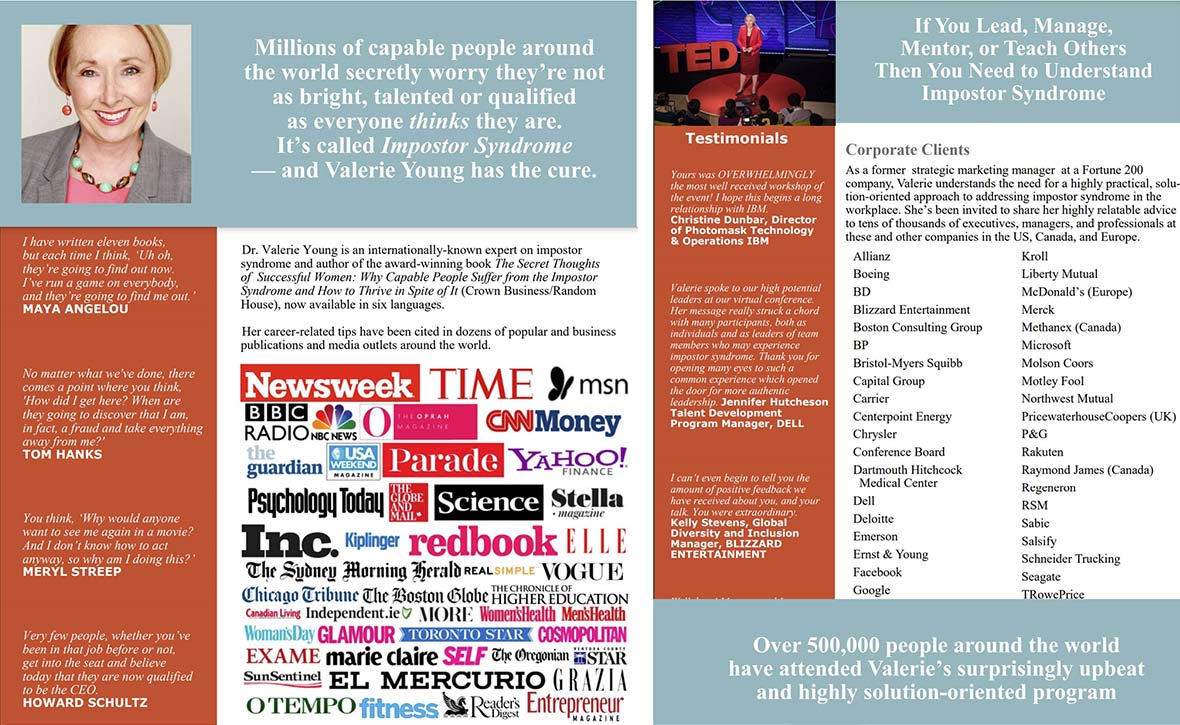 The workshop on 15 April 2021 is co-organized with ArbitralWomen, together with Bryan Cave Leighton Paisner, Betto Perben Pradel Filhol and Lalive. The event is open to members of Mute Off Thursdays, Young Mute Off Thursdays and ArbitralWomen.
As Mute off Thursdays embarks on Year 2, the co-founders look forward to celebrating the power of staying strong together, no matter the circumstances.
See you on Thursdays!
The Mute Off Thursdays full 'syllabus' for its first year (April 2020-April 2021) is here.
The workshop on 15 April 2021 is co-organized with ArbitralWomen, together with Bryan Cave Leighton Paisner, Betto Perben Pradel Filhol and Lalive. The event is open to members of Mute Off Thursdays, Young Mute Off Thursdays and ArbitralWomen.
As Mute off Thursdays embarks on Year 2, the co-founders look forward to celebrating the power of staying strong together, no matter the circumstances.
See you on Thursdays!
The Mute Off Thursdays full 'syllabus' for its first year (April 2020-April 2021) is here.
On Thursday, 15 April 2021, Mute Off Thursdays will celebrate its First Anniversary by hosting a special session about Imposter Syndrome & How to Overcome It with a star speaker – Dr. Valerie Young – an internationally recognized expert on impostor syndrome who regularly lectures on the topic and authored the award-winning book, “The Secret Thoughts of Successful Women”, in which she teaches practical ways to banish the intrusive thoughts that undermine women’s ability to feel — and act — as bright and capable as they truly are.
The workshop on 15 April 2021 is co-organized with ArbitralWomen, together with Bryan Cave Leighton Paisner, Betto Perben Pradel Filhol and Lalive. The event is open to members of Mute Off Thursdays, Young Mute Off Thursdays and ArbitralWomen.
As Mute off Thursdays embarks on Year 2, the co-founders look forward to celebrating the power of staying strong together, no matter the circumstances.
See you on Thursdays!
The Mute Off Thursdays full 'syllabus' for its first year (April 2020-April 2021) is here. 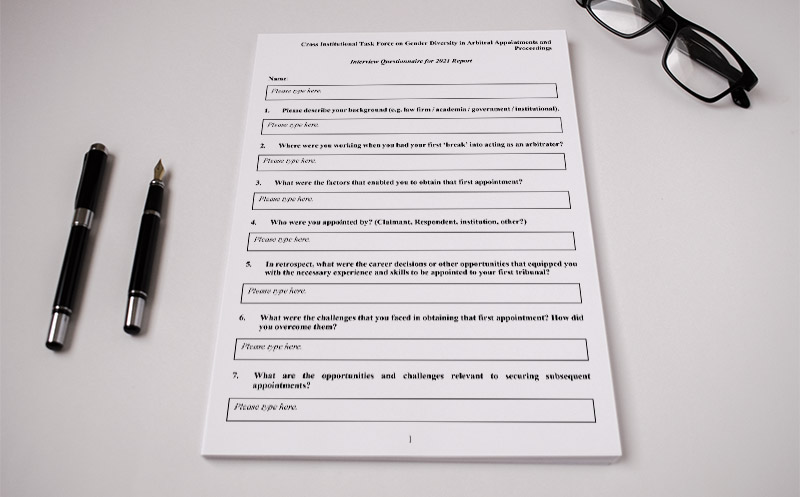
2021-04-06 00:00:00
Call for Participation in Questionnaire for the Cross-Institutional Task Force on Gender Diversity in Arbitral Appointments and Proceedings
ArbitralWomen is an integral member of the Cross-Institutional Task Force on Gender Diversity in Arbitrator Appointments and Proceedings. The Task Force brings together leading international arbitration institutions, law firms, and gender diversity initiatives to publish and analyse recent statistics on the appointment of women as arbitrators, as well as to identify opportunities and best practices to promote gender diversity in international arbitration. In 2020, the Task Force published a Report through ICCA that documented progress towards achieving greater gender diversity among arbitrators, analysed why fewer women than men are appointed as arbitrators, and provided suggestions on how to improve gender diversity in arbitration. Further information about the Report is available in ArbitralWomen’s article here. One extremely valuable source of information was a selection of women, who generously agreed to answer a short questionnaire discussing their experiences securing arbitral appointments. These responses were anonymised and included in the 2020 Report, providing a rich source of shared experience and advice for young practitioners, as well as new and upcoming arbitrators, and offering valuable recommendations on how to address leaks in the “pipeline” of women obtaining arbitral appointments. The Task Force is publishing an updated report this year and invites all women, including ArbitralWomen members, who have served as an arbitrator to complete its Questionnaire, which is available here. Questionnaire responses will be anonymised before being included in the Report. Please send the completed Questionnaire to ArbitralWomen members Nicola Peart atMore information about the Cross-Institutional Task Force and the ICCA Report
The 2020 Report draws on data provided or published by members of the Task Force (DIS, HKIAC, ICC, ICDR, ICSID, LCIA, SCC, and VIAC), as well as publicly available data published by the PCA and CAS, and surveys conducted by the Task Force with a range of women with experience of serving as arbitrators. The 2021 Report will also include data from new Task Force members, ACICA, SCAI, and SIAC. In its 2020 Report, the Task Force examined and identified key trends in the statistics on arbitral appointments. As detailed in the 2020 Report, for example, the proportion of women serving as arbitrators nearly doubled from 2015 to 2019, rising from 12.2% of arbitrator appointments to 21.3% of appointments. Multiple factors likely influenced this increase in appointments, such as improvement in tracking and reporting data and increased awareness following the launch of diversity campaigns such as the Equal Representation in Arbitration Pledge and the work of organisations like ArbitralWomen. The Task Force considered the two primary categories of barriers to the appointment of women as arbitrators, as identified by independent arbitrator and former ArbitralWomen Board member Lucy Greenwood, namely, the “leaks” in the pipeline of sufficiently-qualified arbitrator candidates and the “plugs” in the pipeline that prevent already-experienced women from obtaining arbitrator appointments. Among other pipeline “leaks,” women have faced the impact of unconscious bias on their professional development; difficulties due to inflexible working arrangements; poor retention in law firms; and harassment and bullying in the workplace. “Plugs” in the pipeline include limited and less accessible information about more diverse arbitrator candidates; unconscious bias in the arbitrator selection process; and difficulties in obtaining the first appointment as an arbitrator. In addition to publishing the statistics on gender diversity in arbitrator appointments and analysing why these statistics are still so poor, the 2020 Report compiled and provided recommendations on how to improve the representation both of women as arbitrators on tribunals and of women as lawyers in arbitral proceedings. These recommendations included targeted suggestions for qualified arbitrator candidates, external and in-house counsel, and parties who appoint arbitrators, as well as appointing authorities. These concrete recommendations included tips on addressing unconscious bias; guidance for less-experienced women working as attorneys who seek to progress their careers; advice for employers on how to enable and promote talented women; opportunities for qualified women to promote and market their credentials; and recommendations on how parties and funders can require diversity in international arbitration. The Task Force is currently updating the Report, with a new version to be published later this year, and seeks to include information, advice, and recommendations provided by the current generation of women serving as arbitrators. Submitted by Nicola Peart and Jennifer Ivers, ArbitralWomen members
2021-03-30 00:00:00
The use of party-appointed experts in international arbitration has been the subject of debate for years. The primary role of experts is to assist the arbitral tribunal on matters within his or her expertise and that may be outside the expertise of the arbitrators. In practice, the role of experts can be far broader. In some cases, experts are retained to provide advisory and other support to the client and/or arbitration counsel team at an early stage, before becoming a testifying independent expert or in parallel with the work of a separately engaged testifying expert.
Increasingly, women are acting as either advisory or testifying experts in international arbitration after decades of the expert field being male dominated.
The party-appointed testifying expert treads a delicate line with respect to independence. On the one hand, the expert is contractually engaged and is paid for their time performing services on the case. Naturally, the expert may want to support the party and potentially receive subsequent engagements. On the other hand, the testifying expert has a duty to remain independent, assist the arbitral tribunal and avoid acting as advocate for the party that appointed the expert.
Recently, there has been concern that party-appointed experts and/or expert reports have become expensive vehicles by which the parties reargue their respective cases. There is also a perception by some that party-appointed experts are essentially advocates in disguise, which has had an adverse impact on the evidentiary weight that some arbitral tribunals give to party-appointed experts’ evidence.
The 2021 survey prepared by BCLP’s International Arbitration Group focuses on the perceived problems with party-appointed experts. Are there practical steps that can or should be taken to mitigate the perceived problems with party-appointed testifying experts? If so, who should take the lead in implementing such steps? Are there better alternatives for adducing expert evidence in arbitration? What can be done to preserve the role and usefulness of the party-appointed testifying expert?
This initiative is led by ArbitralWomen member Claire Morel de Westgaver, who commented, “Having the views of various stakeholders including arbitration users, arbitrators and expert witnesses themselves will help identify realistic solutions and ultimately continue to shape the future of international arbitration in an ever more complex world where expertise is bound to become increasingly significant.”
The expert evidence survey will benefit from input from a diverse cross-section of the international community, including female practitioners, arbitrators, clients and experts.
You can participate in the survey here.
Submitted by Dana MacGrath, ArbitralWomen President and Omni Bridgeway Investment Manager, Legal Counsel
2021-03-30 00:00:00
Submitted by Svenja Wachtel and Sneha Ashtikar
Arbitration Happy Hour is a new format launched by ArbitralWomen member Svenja Wachtel and Jus Mundi’s Sneha Ashtikar on Clubhouse. Clubhouse is a social networking app based on audio-chat, a mix between talkback radio, conference calls, and Houseparty. Users can listen in to and join various conversations, interviews, and discussions – it is just like tuning in to a podcast and actively participating.
Sneha and Svenja started the “Arbitration Happy Hour” series on 11 February 2021, talking for 30 minutes about Moot Courts. Following this successful kick-off event, they decided to turn the “Arbitration Happy Hour” into a regular event. Every Thursday, you can join Svenja and Sneha at 6pm (CET) for discussion about various arbitration-related topics.
The second event focused on “Racial Diversity” and featured ArbitralWomen Board member Rekha Rangachari. Rekha spoke about Racial Equality for Arbitration Lawyers (R.E.A.L). R.E.A.L is a newly launched initiative by a group of global lawyers practicing international arbitration committed to achieving racial equality in arbitration.
“Arbitration Happy Hour” has subsequently featured other fabulous guests, including Mahnaz Malik (Twenty Essex) who explored whether arbitrators should be on social media or not, Lise Alm (SCC), who discussed the recently published report on “Diversity in Arbitrator Appointments” and ArbitralWomen President Dana MacGrath, who shared her views for International Women’s Week.
Future events will cover topics such as the importance of mental health for lawyers, building a personal brand in arbitration, power of networking, etc.
Together with Sajid Suleman, Svenja and Sneha have also created an “International Arbitration” club on Clubhouse, where everyone interested in arbitration is welcome and invited to host rooms to let the arbitration community grow.
This email address is being protected from spambots. You need JavaScript enabled to view it. ) and Sneha (This email address is being protected from spambots. You need JavaScript enabled to view it. ).
As Clubhouse is an invitation and iPhone-only social app currently, Sneha and Svenja want to emphasize that they are happy to send invites to everyone interested in participating in the “Arbitration Happy Hour.” Simply send one of them an e-mail or a message on LinkedIn. Clubhouse has plans to open the platform to everyone in due course.
“We hope to facilitate an exchange of ideas and share experiences on a variety of arbitration-related matters through this new medium,” says Svenja.The goal is to have members of the worldwide international arbitration community tune in and join conversations on various topics to get a diverse perspective on different aspects of international arbitration.
“Arbitration Happy Hour is a fun way to exchange thoughts and meet new people from all around the world through a new digital medium,” explains Sneha.If you have a topic that should be featured on the “Arbitration Happy Hour”, please contact Svenja (
2021-01-07 00:00:00
Submitted by ArbitralWomen Members Eunice Shang-Simpson and Shayda Vance.
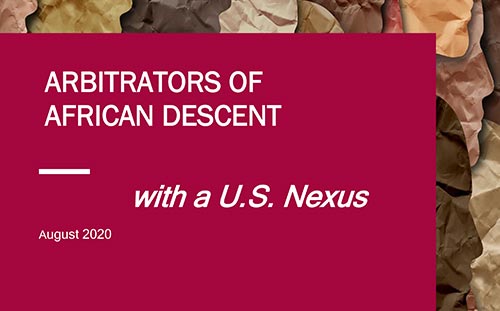
This article reports on the “The New List: Arbitrators of African Descent with a U.S. Nexus” (“The New List”), which New York-based arbitrator Nancy M. Thevenin of Thevenin Arbitration, and Michigan / London-based arbitrator Katherine Simpson of Simpson Dispute Resolution, both members of ArbitralWomen, prepared in response to the perceived shortage of African American arbitrators.
Thevenin and Simpson began their work in February 2020 and initially published The New List in June 2020. In August 2020, Thevenin and Simpson published the first update of The New List, which now contains bios, websites, and contact information for several arbitration professionals of African descent. The New List was compiled based on peer recommendations and referrals from attorneys, institutions, and associations. Thevenin and Simpson are grateful for the advice and assistance of Professor Ben Davis at the University of Toledo and 2018 recipient of the ArbitralWomen Champion of Change Award; Professor Adrien Wing of the BASIL and the University of Iowa; independent arbitrator Brent Clinkscale; Atlanta-based lawyer and President of the National Bar Association Tricia “CK” Hoffler; and the American Bar Association’s minorities committee, among others.
The New List contains 123 potential appointees or hires of African descent and as Katherine Simpson comments, “this alleviates the all-too-frequent lament, the same as inspired the ArbitralWomen Member Directory, that ‘we would hire and appoint, if only we had a list of people to choose from.’” Throughout, the New List has been intended to enable individuals and organizations — whether law firms, institutions, or disputing parties — to find and contact “just the right person” for every role, be that as arbitrator, speaker, expert, counsel, mediator, or even new hire — whether as a lateral or as a newly qualified professional.
The New List includes ArbitralWomen members Deborah Enix-Ross, Mélida Hodgson, Lisa Love, Emilia Onyema, Tina Patterson, Rose Rameau, Rebekah Ratliff, Natalie Reid, ‘Funmi Roberts, Eunice Shang-Simpson, Naomi Tarawali, Nancy M. Thevenin and Shayda Vance.
Tafadzwa Pasipanodya, a US-Zimbabwean partner at Foley Hoag and chair of the firm’s Africa practice group, commented: “Katherine and Nancy deserve high praise for developing this list. Just as the arbitration world is coming to grips with its severe racial diversity deficit, Katherine and Nancy have provided an extraordinary service for those seeking to identify arbitration practitioners of African descent who are ready to be included in tribunal panels, counsel teams, and administrative institutions.”
“It is easy for all of us to pay lip-service to ideals of inclusion and equity, but by putting together this list of highly-qualified arbitrators, Katherine Simpson and Nancy M. Thevenin have done something concrete to promote those ideals in our community,” commented John Fellas, an independent arbitrator at Fellas Arbitration and former co-chair of the International Arbitration practice at Hughes Hubbard & Reed. “They should be commended for producing a resource that all participants in the field of international arbitration - be they clients, law firms, institutions or arbitrators - can and should consult to ensure a more diverse pool of potential arbitrators.”
“I am so honoured to be on this comprehensive list of arbitration practitioners of African descent, and particularly with such talented women, as part of an initiative spearheaded by women,” commented ArbitralWomen member Mélida Hodgson, head of Jenner & Block’s international arbitration practice in New York and Vice Chair of the ICC Institute of World Business Law.
The New List is showing itself to be an important tool to move the arbitration community towards greater inclusivity. Since its publication, the International Institute for Conflict Prevention and Resolution (“CPR”) has invited from the New List, among others, ArbitralWomen members Vivian Zimba and Eunice Shang-Simpson to join CPR’s Panel of Distinguished Neutrals. “There have been a number of perceived obstacles to selecting people of color as neutrals in arbitrations. The New List takes aim at one of those, and provides ready access to talented arbitrators to better ensure that all available talent is being deployed in service of dispute resolution. As noted, at CPR we have invited a number of the neutrals on the New List to join CPR’s Panel of Distinguished Neutrals,” observed Allen Waxman, President & CEO of CPR.
“The list is highly commendable… because it highlights the assertion that there are satisfactory numbers of qualified arbitrators of African descent within the arbitration space”, commented Ijeoma Ononogbu, a London-based solicitor, founder of ADR consultancy Dispute Resolver, and co-chair of the Africa Interest Group at the America Society of International Law. “Arbitrators who continuously raise the bar both within the African continent and in other jurisdictions, especially America, and have chosen to define their career destination intentionally.”
ArbitralWomen Board Member Rose Rameau, Founding Partner of RAMEAU INTERNATIONAL LAW in Washington D.C. and recent nominee to the Permanent Court of Arbitration in the Hague, commented: “Publishing a list of black arbitrators provides needed visibility. It scratches the surface of actions required to resolve the conscious and unconscious biases in the field of international arbitration. There are highly qualified, hard-working, brilliant black arbitrators and arbitration lawyers: this List proves we are here, now hire us. Appoint us.”
“In the nearly 40 years I have been in this field, there has never been a problem of talented people of African descent being unavailable. There has been a problem of them being hired and promoted in the large international arbitration practice groups and institutions or named as arbitrators by parties and institutions,” commented Professor Ben Davis. “And the reasons for that have nothing to do with their ability and everything to do with too many people’s inability to get past their ethnocentrism in an arena that, without irony, is based on a person’s capacity to do cultural gymnastics.”
One of the key benefits of international arbitration is its promise and proven ability to enable different people from different countries and different systems, with different backgrounds, to resolve disputes and even create harmony. It is indeed odd that gender parity and ethnic equity are not already reflected in arbitrator rosters.
“There is growing recognition that in order to maintain trust in the process and its outcomes, the decision-makers in our multi-cultural, multi-state international arbitration system of dispute resolution must reflect its users,” said ArbitralWomen member Edna Sussman, who serves as the chair of the New York International Arbitration Center (NYIAC) and as a director of the AAA/ICDR. “This New List is a signally important contribution to the broad effort that is being made by the arbitration community to increase diversity not only as a matter of fundamental fairness but also in order to a maintain and even foster greater acceptance of arbitration as a dispute resolution mechanism of choice.”
“The New List demonstrates that there is no shortage of highly qualified, talented people of African descent in the international dispute resolution space. It also facilitates the demand for greater diversity in this area of practice, which is entirely within reach” commented ArbitralWomen member Eunice Shang-Simpson. “The New List is also a helpful reminder to reflect on the progress we have made towards diversity within our respective institutions, and of the potential for going further. Inclusion on rosters or panels is important but increasing participation through direct appointments is key.”
Prof. Homer C. La Rue of Howard University, states “I think that one of the most important challenges facing the ADR community is that of making diversity meaningful by taking steps to select diverse neutrals (particularly persons of color and women) as arbitrators and mediators.” Prof. La Rue is currently Vice President of the National Academy of Arbitrators (“NAA”). He has created the Ray Corollary Initiative, which is a program to address unconscious bias in the selection of arbitrators and mediators and which aims for both gender and ethnic diversity in arbitrator appointments.
Nancy M. Thevenin, also a founding member of ArbitralWomen, highlighted that the New List “allows an overlooked group to be seen and for those on the list to see each other”. Although the New List is not an organization and does not replace the important work that organizations do to promote diversity, community is developing within.
ArbitralWomen member Tina Patterson Principal at Jade Solutions, LLC stated, “It was heart-warming to attend the first getting-to-know-you webinar for individuals featured in the Arbitrators of African Descent with a U.S. Nexus List, and to see arbitrators from around the world present. The New List has been a fantastic resource to identify potential collaborators, speakers, and teaming partners for projects.”
“The Arbitrators of African Descent List features dynamic and accomplished professionals in the international ADR community. This curated List has made diverse neutrals visible and top of mind to practitioners and arbitral institutions, to increase appointments and recruit neutrals of African Descent. The list, accompanied by an arbitration inclusion clause will expand the featured neutrals' appointment opportunities,” remarked Joanne Saint-Louis, JAMS Diversity Program Manager. JAMS Neutrals featured on the New List include Hugh L. Fraser, Gail S. Tusan, and James Ware.
“I fully support this project and its identification of highly qualified ADR Professionals of African Descent! This project espouses truth and debunks a falsehood. Its existence is a source of wise guidance and sage advice, and no doubt encourages others to do more of what is good and positive, and less of what is hurtful, harmful and divisive,” said James R. Jenkins, Chairman of the AAA-ICDR Foundation Board, speaking on his own behalf. “ADR Professionals of African Descent have a distinct perspective and grasp of the interpersonal, which is in part influenced by the fact that they are surviving and often thriving in a world flawed by proponents of primitive tribalism, cult, single issue orientation, political affiliation, bias, prejudice or default opinion based on race, and unequal access to justice and opportunity. This important perspective is embodied in dispute resolution processes where People of African Descent preside. Inclusion of People of African Descent will enable ADR to live up to its promise of neutrality, care, empathy and compassion, in action.”
The New List is available online.