

2020-03-31 00:00:00
 ArbitralWomen member Svenja Wachtel has launched a quarterly ‘Digital Coffee Break – International Arbitration’ newsletter series focusing on the practice of international arbitration in the digital age.
Each newsletter features an interview with a member of the international arbitration community, including academics, arbitrators, corporate counsel and others practicing in the field. Svenja tackles topics such as digitalisation, the use of modern technology and digital transformation in the field of international arbitration.
Based in Munich, Svenja Wachtel is counsel in the arbitration and litigation team at Weil, Gotshal & Manges LLP. She focuses on complex commercial litigation and arbitration, with particular focus on multi-jurisdictional matters. Svenja is admitted to the German Bar and speaks English, German and conversational Spanish. She regularly speaks about digitalisation and its impact on the practice of arbitration.
Read the latest issue of the ‘Digital Coffee Break – International Arbitration’ newsletter here.
ArbitralWomen member Svenja Wachtel has launched a quarterly ‘Digital Coffee Break – International Arbitration’ newsletter series focusing on the practice of international arbitration in the digital age.
Each newsletter features an interview with a member of the international arbitration community, including academics, arbitrators, corporate counsel and others practicing in the field. Svenja tackles topics such as digitalisation, the use of modern technology and digital transformation in the field of international arbitration.
Based in Munich, Svenja Wachtel is counsel in the arbitration and litigation team at Weil, Gotshal & Manges LLP. She focuses on complex commercial litigation and arbitration, with particular focus on multi-jurisdictional matters. Svenja is admitted to the German Bar and speaks English, German and conversational Spanish. She regularly speaks about digitalisation and its impact on the practice of arbitration.
Read the latest issue of the ‘Digital Coffee Break – International Arbitration’ newsletter here. 
2020-03-20 00:00:00
The United Kingdom’s Department of International Trade (UK DIT) seeks to designate up to four individuals to the Panel of Arbitrators and up to four people to the Panel of Conciliators convened by the International Centre for Settlement of Investment Disputes (ICSID). These panels act as rosters from which individual arbitrators or conciliators can be selected for ICSID tribunals, commissions or ad hoc committees. Guidance on the UK DIT’s call for expressions of interest can be found here.
The UK DIT is keen to reach out to a diverse applicant base for these designations. Applicants of all backgrounds are encouraged to apply, particularly from under-represented groups. Applicants should have relevant knowledge and experience of international law, proven organisational skills and meet the qualifications specified in the ICSID Convention.
Please direct applications to a dedicated email address: This email address is being protected from spambots. You need JavaScript enabled to view it.
The deadline for applications in 19 April 2020, so we encourage you to act soon if you wish to apply.
Submitted by ArbitralWomen President Dana MacGrath

2020-03-11 00:00:00
To celebrate International Women’s Day, Careers in Arbitration, an initiative of ArbitralWomen Board Member Amanda Lee, launched its inaugural International Women’s Day campaign titled “24 Hours of Inspiration”.
Careers in Arbitration is an electronic, web-based professional development resource created in response to the challenges faced by those aspiring to enter and excel in the field of international arbitration.
For its “24 Hours of Inspiration”, Careers in Arbitration featured twenty-four women in arbitration on LinkedIn and Twitter over a 24-hour period on 8 March 2020. These 24 women explained who or what inspires them and shared their top tips for success in the field of international arbitration. The featured women hail from across the globe and offered uplifting insights in a day-long celebration of women in the field.
The campaign featured younger members of the international arbitration community, consistent with the mandate of Careers in Arbitration to facilitate the entry and welcome of new and younger faces into the field.
Women profiled in the 24 hour celebration included ArbitralWomen members Vanessa Alarcon Duvanel, Elizabeth Chan, Cherine Foty, Anna Guillard Sazhko, Srishti Jain, Jadranka Jakovic, Silvia Martínez, Naimeh Masumy, Trisha Mitra, Rebeca E. Mosquera, Nicola Swan, Sherlin Tung and Gretta Walters, together with Crina Baltag, Diana Gárate, Camilla Gambarini, Sadaff Habib, Madeline Kimei, Innhwa Kwon, Theominique Nottage, Mercy Okiro, Nania Owusu-Ankomah Sackey, Yael Ribco and Nhu-Hoang Tran Thang.
The campaign concluded with one last slice of inspiration from ArbitralWomen member Sally Kotb. The contributions are available here (the LinkedIn handle of #CareersinArbitration) and will find a permanent home on the Careers in Arbitration website when it launches later in 2020.

2020-02-27 00:00:00
Global Arbitration Review has released its shortlists for the GAR Awards 2020, including the shortlist for the Equal Representation in Arbitration Pledge Award (Pledge Award).
ArbitralWomen is honoured that the ArbitralWomen Diversity Toolkit™ – a bespoke training programme designed to help us see the role played by biases and explore ways to address and overcome them – is among the diversity initiatives shortlisted for the Pledge Award.
Voting is now open for the GAR Awards 2020. GAR subscribers can login and cast their vote here. Voting will close at midnight in London on 1 March. Since so many of us travel to and live in many different time zones around the world, we suggest that those who wish to vote do so by no later than 29 February.
We have set out below the Pledge Award shortlist. Congratulations to all the diversity initiatives that have been shortlisted, many of which are led by ArbitralWomen Members and to which ArbitralWomen has provided its support. While ArbitralWomen would be delighted to win the Pledge Award this year, it is important to recognise that all the shortlisted initiatives contribute to our common goal to promote gender parity and diversity in dispute resolution. The Equal Representation in Arbitration Pledge itself, now with more than 4,000 signatories globally, is also deserving of congratulations for its substantial work to promote diversity. Indeed, GAR awarded the Arbitration Pledge “Best Development in Arbitration” in 2017.
Regardless of the winner of this year's Pledge Award, the shortlist has already put so many worthy diversity initiatives in the spotlight. It is encouraging to see such progress being achieved and pursued on so many fronts.Equal Representation in Arbitration Pledge Award Shortlist:
- ArbitralWomen Diversity Toolkit™ training programmes (rolled out during 2019)
- JAMS introduces an optional diversity and inclusion rider to its standard arbitration clauses and appoints a diversity programme manager (October 2019)
- WWA-LATAM initiative (Women Way in Arbitration Latin America) launched to promote women in arbitration in Latin America (June 2019)
- Lucy Greenwood’s continued efforts to collate data and report on female arbitrator appointment statistics (October 2019)
- 43% of LCIA appointments for 2018 were of female arbitrators (reported 1 April 2019)
- AmCham Peru appoints a majority of female court members (December 2019)
- Katherine Simpson provided CETA signatories with a list of 70 experienced women trade experts for inclusion in the CETA List of Arbitrators (January 2020)
- All three Vice Presidents at the International Commercial Arbitration Court (ICAC) at the Ukrainian Chamber of Commerce and Industry are female (last two appointments made in January and October 2019)
2020-02-22 00:00:00
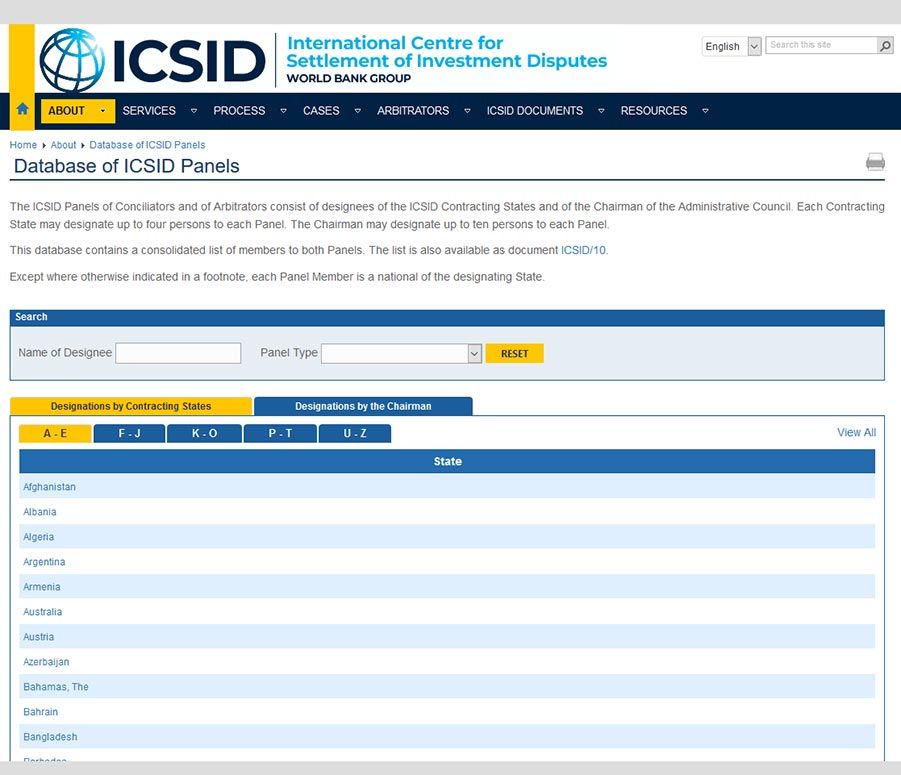
On February 18, 2020, ICSID published an updated list of the Members of the Panel of Conciliators and Panel of Arbitrators ("ICSID Panels"). Notably, this updated list contained the 60 designations made in 2019 by 14 Member States to the ICSID Panels. During the relevant time period, designations to the ICSID Panels were made by Botswana, Denmark, Finland, France, Germany, Honduras, Republic of Korea, New Zealand, Portugal, Qatar, Saint Lucia, Slovak Republic, Sudan, and Uruguay, with some designations being redesignations.
Of these 60 individuals, only 15 are women. Of these 15 women, five were nominated by France and three were nominated by Germany. Botswana, New Zealand, and Finland each made two female designations. Other Member States which made nominations in 2019, including Denmark, Honduras, Republic of Korea, and Portugal, made no female designations at all.
Such Member States are unfortunately not alone in their lack of gender diversity. The ICSID Panels are currently comprised of 680 individuals designated by 125 Member States, but only 132 individuals, or, 19% are women. This includes a remarkable 51 Member States which have made all male designations. Crucially, of the Member States which have designated the maximum number of Panel members (four for each Panel under Article 13(1) of the ICSID Convention although a person may serve on both Panels under Article 16(1) of the ICSID Convention), the following Member States' Panel members are currently all male: Afghanistan, Austria, Barbados, Chile, Cyprus, Egypt, Japan, Republic of Korea, Luxembourg, Malaysia, Mali, Mauritius, Morocco, Paraguay, Portugal, Romania, Saudi Arabia, Singapore, and the UAE.
Conversely, other Member States such as Botswana, North Macedonia, France, Haiti, the United States, Spain, Mexico, Panama, Rwanda, and Zimbabwe have 50% or more women Panel members.
These realities reflect a continued struggle in the fight for gender parity in international arbitration despite the notable strides made towards equality in recent years within the ICSID framework. These figures must also serve as a reminder of the universality of the problem and the universality of efforts to correct it. Gender imbalance is not localized to a particular region and at the same time, gender parity in designations to the ICSID Panels is being achieved by Member States in all corners of the world.
Member States can and should aim to achieve gender parity in their designations with urgency. First and foremost, in accordance with the criteria for designation set forth at Article 14(1) of the ICSID Convention, the 38 Member States which have not yet made any designations to the ICSID Panels, including Bosnia, Canada, Côte d'Ivoire, the Gambia, Iraq, Kazakhstan, Kosovo, Montenegro, Serbia and Turkmenistan should immediately make gender balanced designations while also not excluding prioritizing female candidates to assist in shifting the overall composition of the ICSID Panels towards gender parity more quickly. Member States which have made all male or mostly male designations to the ICSID Panels should, as soon as practicable (i.e. before the next lapse of the term designations) seek to nominate an equal number of female and male candidates.
Encouragingly, the 26 designations made by several Member States in the first couple of months of 2020, which also appear in the updated list, reflect that 12, i.e. almost half, are women. Four of Spain's seven designations are women.
Panel members are integral to the functioning of the ISDS system at ICSID. The Chairman of the ICSID Administrative Council ("Chairman"), when called upon to appoint a Conciliator or Arbitrator pursuant to Articles 30 or 38 of the ICSID Convention, is restricted in his choice to Panel members. Moreover, all appointments to ad hoc Committees must be made by the Chairman from the Panel of Arbitrators under Article 52(3) of the ICSID Convention.
From 1966 to 2019, ICSID appointments of Arbitrators, Conciliators, and ad hoc Committee members totaled 713, of which 637 (89%) were male and 76 (11%) were female. Looking only at the figures for 2019, there has been some improvement: 24 (70%) of ICSID appointments were male while 10 (30%) were female. Yet, when considering Party appointments of Arbitrators, Conciliators, and ad hoc Committee members in 2019, it is striking that claimants appointed men 89% of the time (52 out of 58 cases) and women 11% of the time, despite not being restricted in choice to members of the ICSID Panels. Respondents in 2019 appointed men 69% of the time (29 out of 42) and women 31% of the time (13 out of 42). Said differently, last year the Chairman was three times more likely to appoint women than claimants were and about as likely to appoint women as respondents were, keeping in mind that this result was achieved in spite of the fact that only 19% of the ICSID Panels are currently women. This confirms ICSID's awareness of the problem of gender imbalance and willingness to act to improve it, which can only be expected to yield better results when there is gender parity in the pool of candidates from which the Chairman makes appointments.
Gender parity in the ICSID Panels may also have the added benefit of influencing the parties towards greater gender parity when appointing Arbitrators or Conciliators as (i) Member States having designated women on the ICSID Panels may be more inclined to appoint women in their capacity as respondents, and also because (ii) both claimants and respondents and their counsel may in practice consult the ICSID Panels in their own decision-making process, something which ICSID has indicated that parties are "welcome to do."
Notwithstanding the above, gender parity on ICSID Panels, while necessary, remains just one piece of the diversity puzzle. The legitimacy of the ISDS system as a whole depends also on increasing diversity in other aspects of Arbitrator and Conciliator profiles such as national origin, professional background, race, and religion.
Submitted by Lara Elborno – ArbitralWomen Member and Associate, DLA Piper in Paris.
2020-02-21 00:00:00
 On February 3 through 7, 2020 the UNCITRAL Working Group II (Dispute Resolution) hosted its seventy-first session at the United Nations Headquarters in New York. The five-day session was attended by approximately 60 State members of the Commission as well as numerous other representatives of States, and international governmental and non-governmental organizations.
Also in attendance by invitation by UNCITRAL were representatives of leading arbitral institutions and groups with international expertise relevant to the work of the Working Group (such as the ABA, ArbitralWomen, CEPANI, CIArb, CIETAC, CPR, ELSA, FICA, ICC, ICCA, AAA/ICDR, HKIAC, KCAB, MCA, MIAS, NYIAC, RAS, SCC and SIAC) who attended the Session as observers.
The Working Group continued to prepare a text for expedited arbitration rules (the Expedited Provisions) in furtherance of the vision first articulated by the Commission in 2018 to establish an international framework for expedited arbitration. The aim is to establish streamlined and simplified procedures, model clauses and other guidance to resolve disputes within an expedited or abbreviated timeline and with a particular focus on commercial rather than investor-State arbitration. As highlighted throughout this session, as well as earlier sessions in Vienna, the objective of the Working Group is to establish efficient, user-friendly procedures suitable for use by a range of stakeholders in a variety of settings, including most relevantly in ad hoc proceedings where there is no institution administering the proceedings.
The key issues and discussions points during the Working Group deliberations are summarized below:
On February 3 through 7, 2020 the UNCITRAL Working Group II (Dispute Resolution) hosted its seventy-first session at the United Nations Headquarters in New York. The five-day session was attended by approximately 60 State members of the Commission as well as numerous other representatives of States, and international governmental and non-governmental organizations.
Also in attendance by invitation by UNCITRAL were representatives of leading arbitral institutions and groups with international expertise relevant to the work of the Working Group (such as the ABA, ArbitralWomen, CEPANI, CIArb, CIETAC, CPR, ELSA, FICA, ICC, ICCA, AAA/ICDR, HKIAC, KCAB, MCA, MIAS, NYIAC, RAS, SCC and SIAC) who attended the Session as observers.
The Working Group continued to prepare a text for expedited arbitration rules (the Expedited Provisions) in furtherance of the vision first articulated by the Commission in 2018 to establish an international framework for expedited arbitration. The aim is to establish streamlined and simplified procedures, model clauses and other guidance to resolve disputes within an expedited or abbreviated timeline and with a particular focus on commercial rather than investor-State arbitration. As highlighted throughout this session, as well as earlier sessions in Vienna, the objective of the Working Group is to establish efficient, user-friendly procedures suitable for use by a range of stakeholders in a variety of settings, including most relevantly in ad hoc proceedings where there is no institution administering the proceedings.
The key issues and discussions points during the Working Group deliberations are summarized below:
- Implied consent (opt-out) or express consent (opt-in). One of the key threshold issues – perhaps the threshold issue – is whether parties will have to expressly “opt-in” or consent to the application of Expedited Provisions, or whether the Expedited Provisions, like the expedited rules of some arbitral institutions, will automatically apply to disputes satisfying certain pre-established criteria − including, for example, specified financial thresholds (and provided that the underlying arbitration agreement post-dated the date the Expedited Provisions come into force). Delegates acknowledged that this pivotal decision may have a substantial follow-on impact for the direction of the remainder of the Provisions. For example, if it is clear that parties are knowingly adopting these modifications in the interest of efficiency, it will likely be possible for the drafters to deviate further from the existing rules governing non-expedited arbitration. Two understandings come into play here: first, arbitration is a creature of consent; second, parties to an expedited arbitration are necessarily afforded less due process. Contemplating these two concerns led to significant consensus among delegates that arbitral parties should be required to expressly consent to the adoption of Expedited Provisions, rather than having it presumed that they have consented through the doctrine of implied consent.
- Logistical complications. The deliberations further highlighted the logistical complications arising from the need to determine the applicability of the Expedited Provisions. Not least of these is who determines whether criteria for applicability are being satisfied in the absence of an arbitral institution administering the dispute as well as the interconnectedness of all the matters contemplated by the Provisions. Delegates raised questions about an array of issues emanating from this concern. Amongst other issues, delegates raised issues concerning the constitution of a tribunal— given, for example, that the Expedited Provisions would likely require the appointment of a sole arbitrator, whereas if not applicable, the arbitral agreement might otherwise require a tribunal composed of three arbitrators. This issue alone has potential to create substantial challenges in initiating proceedings in disputes where there is question as to the applicability of the Expedited Provisions. An important takeaway was that any final Expedited Provisions should provide an appropriate level of guidance with respect to this issue.
- Opt-out, take two. Notwithstanding the consensus above, in further discussion, delegates explored whether the Expedited Provisions should permit a party to unilaterally opt-out of the Expedited Provisions, despite any prior agreement to have those Provisions apply. While certain delegates expressed a view that the ability to opt-out would permit a sensible modification in the event of “unforeseeable” or “exceptional” circumstances, others expressed concerns that permitting one party to avoid an arbitration agreement would frustrate central goals of arbitration, such as finality and certainty. The Secretariat was thus asked to further consider when a party could make such an application, on what basis a party could do so, and to which body a party would submit such application, including what would transpire in the event that a tribunal had not yet been constituted and no institution had been designated in the parties’ agreement to resolve such disputes.
- Pleadings: Another area of focus was on the pleadings to be submitted by the parties and the timing for doing so. In particular, delegates discussed whether the Notice of Arbitration should serve as a Statement of Claim and whether a claimant would be required to include all evidence on which it intended to rely with that pleading. Delegates again asked whether, and when, there would or could be a decision regarding the applicability of Expedited Provisions, including the possibility that a respondent might be required to respond only to the issue of applicability (and the appropriate constitution of tribunal), but could be allowed further time to file its responsive pleading.
- Default arbitrator appointment. Delegates also discussed the issue of default arbitral appointments − more specifically, whether UNCITRAL Rules should begin to look to other institutions beyond the PCA to fulfill that role when parties’ agreements have failed to specify an institution for appointment. Various observers suggested it may be time to widen the pool to other institutions who might be better able to offer parties the benefit of localized experience.
- Making the award − how fast is too fast? Many delegates agreed there is a need for tribunals to issue awards rapidly and within a fixed time frame following their constitutions. At the same time, however, delegates acknowledged some of the unique challenges that exist in ad hoc Among the ad hoc arbitration challenges mentioned: whether it would be possible for arbitrators to abide by clear timelines, or whether there is a need to build in flexibility, allowing limited numbers of extensions, for limited types of reasons. Again, the Working Group had differing views on how prescriptive the Expedited Provisions should be in terms of setting forth the specific reasons or rationales which might justify an extension.